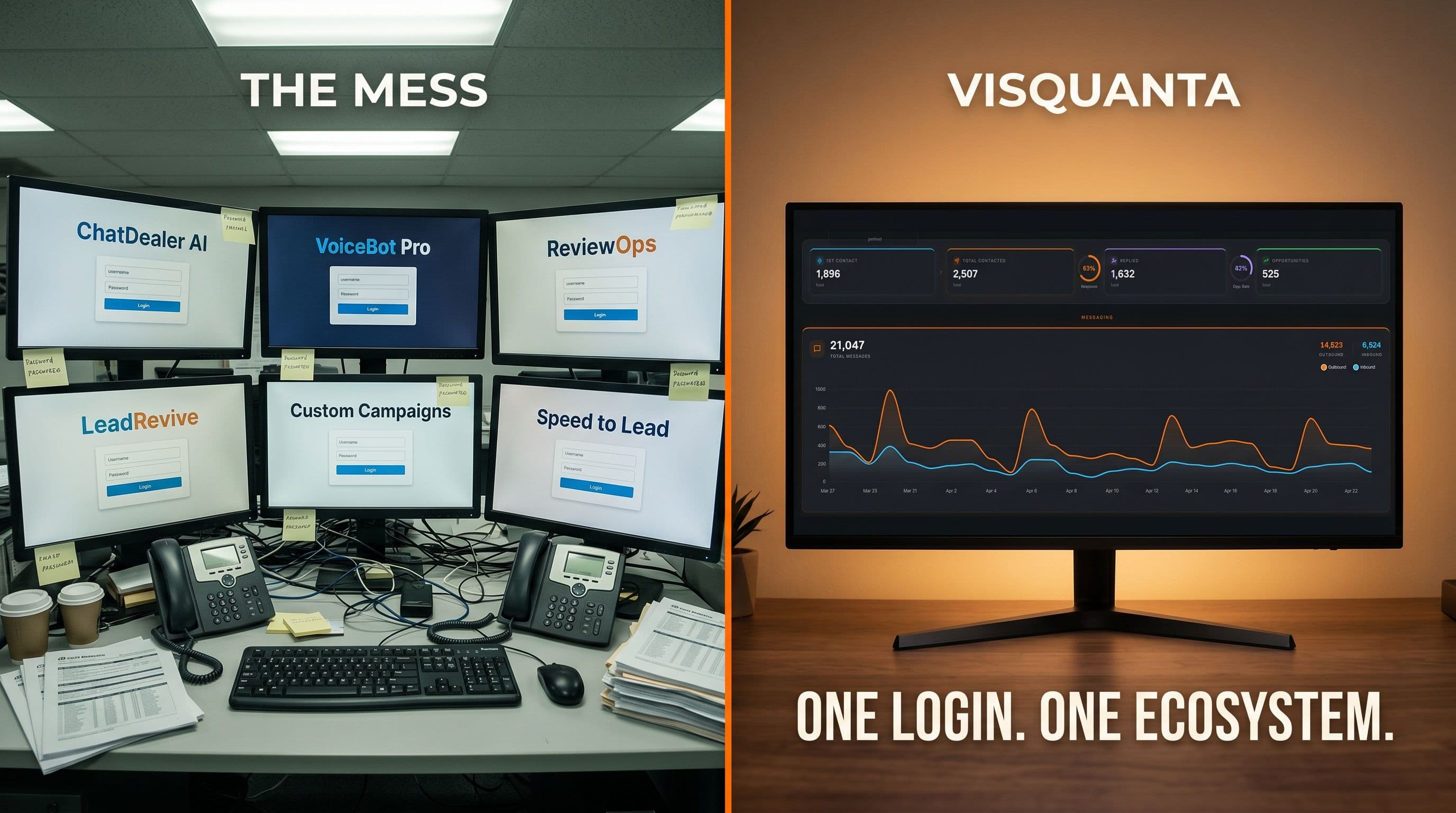
Every quarter your tech vendors send you a dashboard. Logins are up. Messages sent are up. "Leads engaged" is a big green number. You glance at it, file it under done, and move on to the floor plan.
Here's the problem: none of those numbers are on your P&L. They're activity, not value. They tell you whether the tool is being used — not whether it's making you money.
Most dealerships measure ROI on AI tools the way a vendor would prefer: usage metrics that look impressive in a quarterly business review, and silence on the questions that actually matter. Below is the framework we use across 41 rooftops to answer the only question that counts: is this tool producing more dollars than it costs? It includes the five metrics that map to your store's P&L, real numbers from our portal data, named case studies from stores running our Auto Master Suite, and three calculators you can run on your own numbers Monday morning.
Key Takeaways
- Activity dashboards (logins, messages sent, leads engaged) tell you nothing about ROI. Five financial metrics do: incremental revenue, time recovered, reactivation revenue, reputation lift, and service-drive recovery.
- True total cost of ownership runs 3–5× the subscription fee once you add integration, training, internal admin time, and manager oversight.
- Across 41 rooftops in our portal between February and April 2026, layered tools attributed $1,892,160 in revenue — $42,000 average per closed deal, with 92% of contacts being net-new (not warm CRM records).
- A defensible per-rooftop ROI calculation needs four inputs: lead volume, percentage arriving after-hours, conversion delta between fast and slow response, and average front-end gross.
- ROI is not universal. Stores that already run a 24/7 BDC, hit 5-minute response, and have no dormant lead pool will see thinner returns than the median dealer.
Bottom line: Stop reading vendor dashboards as if they were a P&L. Build the calculation once, run it quarterly, and decide each tool's renewal on its own math.
Why activity dashboards lie to you
Vendor success teams are paid to retain you. The metrics they highlight in a QBR are the metrics that make retention look easy — login frequency, messages delivered, tasks completed, features utilized. None of those answer the principal's actual question.
Consider a typical CRM dashboard: 87% of your sales team logged in last month, 15,000 emails sent, 47,000 customer profiles in the system. That looks like a system pulling its weight. But:
Get weekly AI strategies for your dealership
Join 2,500+ automotive professionals. No spam.
- Login rate measures compliance, not value. A system people are forced to use isn't necessarily one producing returns.
- Message volume without conversion data tells you nothing. 15,000 emails could mean 30 appointments or zero.
- Database size correlates with age, not health. Half those profiles are likely dead addresses or duplicates.
- Feature utilization is complexity, not outcome. Using 14 of 23 features doesn't mean any of them moved a deal.
This applies just as directly to every layered tool sitting on top of your CRM — voice agents, chat widgets, SMS engagement platforms, reactivation engines, reputation managers. Activity reports are designed to make renewal feel obvious. Financial reports are the ones that should drive the renewal decision.
The five metrics that actually map to your P&L
Five buckets cover the full picture of what a layered tool can produce. Build a number for each. Add them up. That's your annual value side.
1. Incremental revenue from coverage gaps closed
The single biggest line. How many deals are you closing now that you weren't before, because something is covering hours and channels your team didn't?
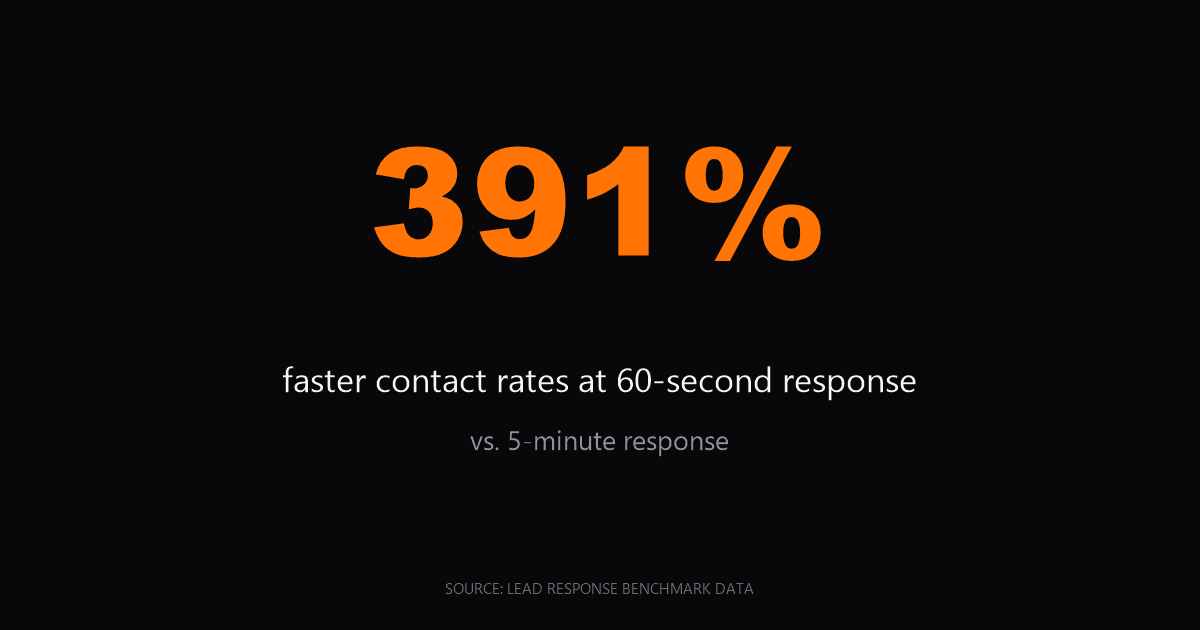
Pull your inbound lead and call data and ask: what percentage arrives outside your staffed hours? For most stores it's 35–45% — evenings, weekends, lunch peaks, and the morning rush before BDC is fully on the floor. Cox Automotive's Car Buyer Journey research consistently finds the majority of vehicle research happening outside business hours, and the conversion gap between a lead contacted in 5 minutes and one contacted next business day is severe. Our breakdown of speed-to-lead math puts a 5-minute reply at 100× the close odds of a 30-minute one.
Multiply: after-hours lead volume × the conversion delta × your average front-end gross. That number is the annualized revenue your store is leaving on the table without coverage. It is also the ceiling on what any after-hours tool can recover for you.
{{calculator:speed-to-lead}}
2. Time recovered from staff
Every minute a salesperson, advisor, or BDC rep spends on data entry, routing, or chasing routine status calls is a minute they aren't selling or servicing. Quantify it.
A traditional BDC requiring 2–3 hours of daily manual lead-entry and follow-up admin per rep costs a 10-person team $50,000–75,000 a year in labor overhead, before you count the opportunity cost of the deals those reps didn't work. Tools that capture that overhead — autonomous lead capture, automated follow-up sequences, voice agents handling status calls — recover that labor as either reduced headcount or redeployed selling time. One 5-rooftop auto group in central Oklahoma we work with handled 2,059 customer conversations in 60 days without adding BDC headcount — the time-recovered metric in concrete form.
Multiply recovered hours by fully-loaded hourly cost. Cut it in half if you're being conservative. It's still a real number on your bottom line.
3. Reactivation revenue from dormant leads
Most CRMs hold tens of thousands of customer records. Most of those records are sitting cold. A reactivation engine that systematically re-engages dormant leads and routes the warm ones back to your floor produces revenue from a pool you've already paid to acquire.
The math is straightforward: dormant lead pool × reactivation engagement rate × close rate × average front-end gross. The reactivation engagement rate is what you measure to know the tool is doing its job — but the gross dollars are what you measure to know it's earning its subscription. See our breakdown on lead reactivation systems for the operational side, and our reactivating old leads guide for the timing rules that actually move close rates.
{{calculator:lead-reactivation}}
4. Reputation lift translated into store visits
Reputation tools earn their keep by raising review velocity and store rating, which lifts your SRP/VDP click-through and ultimately your form-fill volume. The chain is real but the attribution is indirect, so most dealers either over-claim it or ignore it entirely.
Track three things over a 90-day window after deploying a reputation system: monthly review volume, average rating, and inbound web lead volume. Compare to the prior 90-day baseline. The lift in inbound volume — multiplied by your normal lead-to-sale conversion rate and gross — is your reputation revenue line. Our guide to dealership reputation metrics walks through the specific KPIs to watch, and the reputation-is-revenue breakdown covers the SRP-CTR mechanism in depth.
5. Service-drive recovery
Service is where most stores quietly lose six-figure revenue. A missed service call at 7:45 a.m. before the advisor is on the floor is a customer who calls a competitor next. Equity contacts triggered from service appointments — the service-to-sales bridge — is another vein most stores leave underexploited.
The numbers are dealer-specific but the size is consistent across our portfolio. A rural independent rooftop closed $110k in 60 days. A small-town Chevrolet store generated $153k in the same window with thin staffing. A single Hyundai rooftop in Texas returned $238k. Numbers in that range are normal once service-call coverage and equity routing are running.
If you want to hear what a service-call coverage tool actually sounds like answering an inbound call, the service drive page has a live voice agent widget — click it, talk to it, and you'll hear the same agent your customers would.
{{calculator:service-roi}}
Real numbers: what 41 rooftops produced
Here is what the framework looks like when applied to actual portal data, not a vendor's marketing deck.
Across the 41 rooftops in our network during the February–April 2026 window:
- 1,414 conversion events captured by layered web-capture and chat tooling
- 1,302 unique contacts behind those events, of which 92% were first-time — meaning these were not warm CRM records being re-touched, they were net-new pipeline
- 45 sold deals attributable to the chat-widget channel alone
- $1,892,160 in attributed revenue
- $42,000 average per closed deal, in line with the industry's front + back gross norms
Cumulative across the full client base, our deployed AI agents have generated $48M in dealer revenue to date — paired with the team-time the same systems give back to BDC and service teams every week. The full breakdown of which products do which work lives on our dealer services overview. Per rooftop, the recent 90-day window worked out to roughly $46,000 of attributed revenue from a single channel — chat. The other four buckets compound on top of that figure when their tools are also deployed.
Compare this against named outcomes from stores running the Auto Master Suite bundle:
- 5-rooftop auto group in central Oklahoma — Chevrolet and Ford franchises running on one playbook: $1.29M attributed revenue, 37 confirmed sales, 2,059 AI-handled customer conversations (60-day window).
- Hyundai rooftop in Kansas City — single store in one of the most competitive Hyundai metros in the Midwest: $271k revenue, 11 sales, 722 AI-handled contacts (60 days).
- 3 independent Colorado rooftops — proof the playbook works off-franchise: $228k revenue, 13 sales (60 days).
- Ford store in Nampa, Idaho — single rooftop, every lead answered instantly: $125k revenue at a $41k average deal value (60 days).
The pattern is consistent. The dollar amounts are not theoretical.
The total cost side most dealers underestimate
Subscription is the smallest line. Build a real total cost of ownership figure before you celebrate the value side.
The full stack:
- Direct costs: subscription fee, integration to DMS/CRM/website/phone system, add-on modules, training and onboarding, ongoing support
- Hidden costs: internal admin time (the BDC manager who babysits the tool), oversight time (the GM who reviews the dashboard), opportunity cost of manual processes the tool was supposed to eliminate but partially failed to, and vendor coordination time
For a mid-size store, total cost runs 3–5× the stated subscription when everything is accounted for. A tool with a $1,500/month invoice often lands at $60,000–90,000 a year in fully-loaded cost. That is your real baseline. The annual value side has to clear it cleanly to justify renewal — and a bundled platform like the Auto Master Suite, where speed-to-lead, reactivation, reputation, and service coverage share one integration and one admin overhead, often clears it more easily than four separate point tools.
The four-step calculator: run this on Monday morning
You do not need a finance team or a quarter of clean data to run this. You need four numbers, an hour, and a spreadsheet.
- Pull 90 days of lead data from your CRM. Bucket each lead by response time: under 5 minutes, under 1 hour, under 4 hours, next business day. Calculate close rate per bucket.
- Identify after-hours leads. What percent of your inbound lands outside staffed hours? Multiply that share by your annual lead volume to get your annual after-hours volume.
- Calculate the conversion delta. Subtract the close rate of "next business day" leads from the close rate of "under 5 minutes" leads. That delta is the rate your store is losing on every after-hours lead that goes to a competitor first.
- Multiply through. After-hours lead volume × conversion delta × average front-end gross = annualized revenue your store is leaving on the table. Subtract the fully-loaded cost of any tool claiming to recover that revenue. What's left is your real ROI in dollars.
If the result is comfortably positive, the tool is earning its keep. If it's marginal, you have a measurement problem or a tool problem and need to know which before the next renewal. Our lead-loss measurement guide walks through the diagnostic in more depth.
When the ROI is genuinely low
This framework cuts both ways. If your store already runs a fully-staffed 24/7 BDC, hits 5-minute response on inbound consistently, has a sub-2% rate of leads stuck in "next business day," and has no dormant pool worth reactivating, then layered tools have less to recover for you. Their marginal ROI will be small.
The honest truth: most dealers aren't there. The 7% of stores that hit a 5-minute response window are the exception, not the median. For everyone below that line, the recoverable revenue is real, measurable, and large.
What the framework does is force the question into the open: measured against what we just calculated, is this tool clearing its cost or not? That's the right question to ask in a renewal conversation, and it's the conversation most dealers have never had with their vendors.
Bottom Line
Five financial metrics — incremental revenue, time recovered, reactivation revenue, reputation lift, service recovery — are the only honest measures of a layered tool's ROI at a dealership. Activity dashboards are not. Build the calculation once per tool, run it quarterly against your real numbers, and let the math drive renewal. A tool that clears its fully-loaded cost on the value side is a keeper. One that doesn't is a line you should cut.
Walk through your numbers with our team If you'd like a session that applies the calculator above to your store's actual lead data, book a walkthrough. We'll run the math live, show where the recoverable revenue is, and you'll leave with a defensible ROI number — whether or not you ever work with us. To see how the individual products map to each ROI bucket, the dealer services page has the full breakdown, and the Auto Master Suite page shows how speed-to-lead, reactivation, reputation, and service coverage work as a single bundle.
Frequently Asked Questions
How long does it take to measure tool ROI accurately? A defensible first-pass calculation needs 90 days of lead and conversion data and roughly an hour to build the spreadsheet. A confident steady-state read takes two full quarters of data — one quarter to baseline before the tool, one to measure with it deployed. After that, the math holds and you only need to refresh inputs quarterly.
What's the most common mistake dealerships make when calculating ROI? Anchoring on subscription fee as total cost. The subscription is typically 20–35% of fully-loaded cost once you add integration, training, internal admin time, and oversight. Skipping those line items makes any tool look more profitable than it actually is.
Should I trust vendor-reported ROI numbers? Use them as directional, not as truth. Vendor case studies select for their best customers and best outcomes. Run your own math on your own data before signing or renewing. Our published case studies are full deployments at named rooftops — you can see the inputs and the numbers and apply the same model to your store.
Which tool category usually has the strongest ROI for a mid-size dealership? Coverage tools — the ones that close after-hours and overflow gaps — almost always lead, because the after-hours lead volume at most stores is 35–45% of inbound and the conversion gap between fast and slow response is steep. Reactivation engines come second when there's a dormant lead pool to work. Reputation tools and service-side recovery tend to be slower-burn but durable.
How is this different from measuring CRM ROI? Same framework, different scope. CRM ROI usually compares system cost against incremental sales attributable to the platform itself. Layered tools — voice agents, chat widgets, reactivation engines, reputation managers — sit on top of the CRM and produce revenue the CRM alone wouldn't. Apply the five metrics to each tool individually rather than to your stack as one bundle, or evaluate a unified platform like the Auto Master Suite as a single line on your tool stack.