
Memory Costs Are Spiking - and Your Lot Prices Will Follow
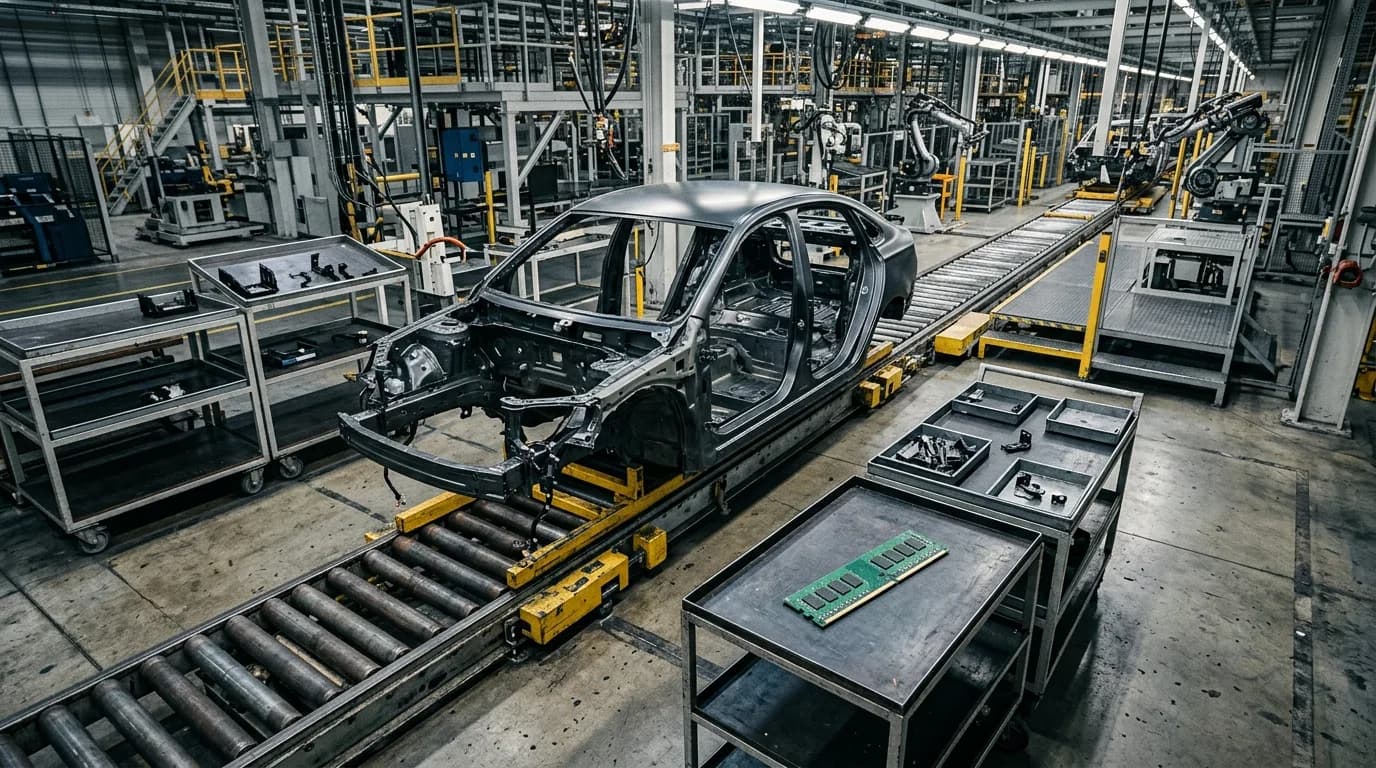
A 16 GB RAM module cost $110 seven years ago. That same part runs north of $240 today , according to Thedrive. That cost escalation doesn't stay in the PC aisle. Modern vehicles run on the same memory silicon - and when bill-of-materials climbs because of chip economics, the ripple hits OEM invoices, dealer margins, and the window sticker a shopper sees on the lot.
90 GB of memory per vehicle. That's Micron's 2023 estimate for a typical car - infotainment, ADAS, powertrain controllers all stacked together . For context, plenty of flagship smartphones in 2020 shipped with less onboard storage. Here's why that number matters to dealers: automotive and consumer-electronics memory rolls off the same fab lines, competing for the same wafer capacity. A supply squeeze anywhere in the semiconductor market lands directly on OEM component budgets - and eventually on the price tag your desk has to defend.
Industry forecasts projected per-vehicle memory demand would effectively triple by 2026 - pushing the average car toward roughly 270 GB. Pair that explosive growth with a supply chain already stretched thin by datacenter demand for the same chips, and the math turns grim. Component cost pressure is flowing directly into wholesale pricing and eventually into the sticker numbers dealers present to buyers.
Automotive Memory Cost and Demand Trajectory
| Metric | Previous / Baseline | Current / Projected |
|---|---|---|
| 16 GB RAM module cost | $110 (seven years ago) | $240+ today |
| Per-vehicle memory (typical car) | 90 GB (2023 Micron estimate) | ~270 GB (2026 projection) |
| Demand growth factor | Baseline | Effectively tripled by 2026 |
Key Takeaway: Per-vehicle memory demand is projected to triple to roughly 270 GB by 2026, compounding a chip-cost squeeze that is pushing new-car prices higher while households earning $150K+ already account for over 40% of new-car purchases. Dealers face a narrowing buyer pool, unpredictable component costs, and a digital-to-showroom handoff problem that 93% of shoppers say wastes the time digital tools were supposed to save.
New Cars Are Already a Luxury - This Makes It Worse
The buyer pool was already narrowing before memory costs started climbing. Households earning at least $150,000 now account for over 40% of new-car purchases - effectively turning the new-vehicle segment into a premium market by default. For a dealer whose territory skews toward median-income households, that demographic tilt means thinner foot traffic and heavier reliance on incentive programs to close deals.
Here's the disconnect: there is no reliable forecast for how long this memory-driven shortage will persist or how deeply it will affect car buying through the balance of 2026 . That ambiguity is the problem. Dealers can't plan inventory mix, negotiate floor-plan terms, or set marketing budgets when a key cost input stays unpredictable - yet standing still while the market shifts around them carries its own risk.
Get weekly AI strategies for your dealership
Join 2,500+ automotive professionals. No spam.
The Drive frames the consumer mood bluntly: yet another chip shortage gives buyers one more reason to consider older, lower-tech vehicles instead of new ones . That gravitational pull toward the used lot - or toward simply keeping a current vehicle longer - tightens demand for the very new inventory already carrying elevated sticker prices. Dealers watching this play out need to weigh how long high-priced new stock can sit before floor-plan interest erodes whatever margin remains.
New-Car Buyer Demographics and Market Pressure
| Factor | Data Point |
|---|---|
| Household income share of new-car purchases ($150K+) | Over 40% |
| Forecast reliability for memory-driven shortage duration | No reliable forecast available |
| Consumer alternative trend | Shift toward older, lower-tech vehicles or keeping current vehicle longer |
| Dealer risk on aging new inventory | Floor-plan interest erodes margin on high-priced stock |
Digital Retailing Saves Time - Until It Doesn't
90% of stores in Cox Automotive's recent dealer survey reported measurable gains in at least one operational category after adopting digital retailing , as reported by Autonews. That last data point matters: the improvements aren't clustering in a single function. They span deal-desk throughput, F&I efficiency, and customer-engagement metrics all at once. For dealer principals weighing where to allocate shrinking discretionary budgets, that cross-functional payoff explains why digital retailing spend keeps surviving the chopping block when other line items don't.
Consumers are equally bullish - at least in theory. The same Cox Automotive research showed 93 percent of car shoppers said digital retailing tools saved them time during the purchase process. On paper, that is a win-win: the store moves faster, the buyer feels respected, everyone gets to closing sooner.
Yet enthusiasm on both sides of the desk masks a structural weakness. Cox Automotive's data confirms a majority of shoppers remain unwilling to finalize the entire purchase through a screen - they still want to close in the physical showroom . That preference creates a mandatory transition point - digital to physical - and it is exactly at this junction that the experience degrades. The two environments rarely share data cleanly, turning what should be a continuation into an awkward restart.
When customers arrive on the lot, they end up repeating steps they already completed online - re-entering personal information, re-selecting trade-in details, re-confirming payment preferences. That redundancy erodes the time savings they were promised and chips away at satisfaction. Fixing this broken handoff is the single highest-leverage improvement most stores can make in 2026.
Digital Retailing Adoption - Dealer and Shopper Metrics
| Metric | Value | Source |
|---|---|---|
| Stores reporting measurable operational gains | 90% | Cox Automotive dealer survey |
| Shoppers who said digital tools saved time | 93% | Cox Automotive research |
| Shoppers willing to finalize entire purchase online | Minority | Cox Automotive data |
| Key pain point | Repeating steps already completed online | Cox Automotive / dealer feedback |
Showroom Automation Is Already Cutting Headcount Overseas
South Korea is already stress-testing what showroom automation looks like in a live retail environment. Automation vendor Epikar has placed its products inside Renault, BMW, and Volvo rooftops across the country , per Thedrive. The number that should sharpen attention for U.S. operators: Renault's Seoul store staffs three salespeople - exactly half the headcount at comparable Renault showrooms in the same market running without the platform, according to Epikar's CEO. Whether that labor reduction holds up across higher-volume American stores is an open question. But the Korean pilot converts an abstract efficiency promise into a documented personnel change at a branded, customer-facing location.
Epikar's ambitions extend well beyond the Korean peninsula. The company has signaled plans to enter the U.S. market and - according to reporting from The Drive - is already running its technology at a minimum of one American dealership . For domestic dealer principals tracking automation trends from a comfortable distance, that detail collapses the timeline considerably. The pilot phase is not hypothetical. It is underway on this side of the Pacific.
The pitch is pointed: imagine a salesperson who never takes a break, pulls spec sheets and incentive details from the entire internet in real time, and collects zero commission . That resonates with any operator who has watched margin evaporate into personnel costs. Here's the disconnect: the customer-facing kiosk product is early-stage. Renault, BMW, and Volvo are running Epikar's established back-office automation suite - not the forthcoming showroom agent. The distance between a proven administrative tool and an unproven floor-facing product is exactly where dealer principals need to apply the most scrutiny before signing a pilot agreement.
Showroom Automation - South Korea Pilot Results
| Detail | Automated Store (Renault Seoul) | Comparable Non-Automated Store |
|---|---|---|
| Salespeople on staff | 3 | 6 (double the automated store) |
| Automation vendor | Epikar | N/A |
| OEM brands using Epikar in Korea | Renault, BMW, Volvo | N/A |
Ready to stop losing revenue to missed calls? Schedule a strategy call with the VisQuanta team - we'll audit your after-hours coverage and show you exactly where the gaps are.
Fixed Ops: Where Automation Pays Without Replacing Anyone
Positioning Automation as a Tool, Not a Threat
If showroom automation feels threatening, the service lane offers a gentler on-ramp. Industry advisors stress that automation should be introduced to fixed-ops employees as a resource for eliminating mundane, repetitive tasks - not as a replacement for anyone's position. When technicians and advisors see the technology handling scheduling grunt work or parts lookups, adoption tends to follow naturally.
Personalized Service Recommendations at Scale
One of the highest-value applications is customer profiling. Automated systems sift through detailed vehicle and owner data to build personalized profiles, then generate tailored service recommendations for each customer. The result: a service advisor who walks into every appointment armed with specific, data-backed upsell opportunities instead of generic mileage-based suggestions.
Predictive Maintenance Scheduling
At the foundation of automated service scheduling sits a layer of machine-learning models trained on telematics feeds from connected vehicles , research from Cbtnews. These algorithms correlate mileage patterns, driving conditions, and component-wear indicators to project when each car genuinely needs attention - replacing the blunt instrument of calendar-based reminders with a data-informed estimate. The practical upside for the service department is twofold: customers arrive before a breakdown rather than after one, and appointment flow becomes more predictable - helping advisors keep bay utilization steady throughout the week.
Wear-and-Tear Packages That Sell Themselves
When a dealership's system continuously tracks real-world vehicle data, it can assemble maintenance bundles centered on the parts most likely to need replacement next - brake pads approaching minimum thickness, batteries showing diminished cold-crank performance, tires nearing tread-depth thresholds . Anchoring each recommendation to measurable telemetry rather than a static mileage chart shifts customer perception: the suggestion reads as diagnostic insight, not a scripted upsell. That credibility gap is what separates a declined recommendation from an approved RO.
Three Steps to Prepare Your Store Before Q3
Getting ahead of these converging forces does not require a massive capital outlay, but it does require deliberate action before Q3. Three steps every dealer principal should prioritize:
- Audit your supply-chain exposure. Ford's CFO was recently pressed on constrained memory supply at the Wolfe Research summit on automotive tech and semiconductors. If an OEM the size of Ford is fielding public questions about chip availability, your store needs a clear picture of which incoming models carry the highest component-cost risk - and which alternatives you can pivot to.
- Fix the digital-to-showroom handoff. Customers repeating online steps once they arrive in person destroys the time savings your digital retailing platform promised and drags down satisfaction scores. Map every data field a shopper enters online and confirm it flows into your DMS without requiring re-entry.
- Pilot service-lane automation on one use case. Fixed ops faces rising customer expectations, evolving vehicle technology, and intense competitive pressure from independent shops and quick-lube chains. Start with a single automated workflow - predictive maintenance scheduling or personalized service packages - measure the impact over 90 days, and expand from there.
That last point matters: the digital handoff problem is not a technology gap - it is a process gap. When shoppers repeat steps they already completed online, the promised time savings evaporate and overall dealership satisfaction takes a hit. Closing that loop is the single easiest win on your Q2 punch list.
Fixed ops sits at the intersection of three persistent pressures the source identifies: customers who expect faster, more transparent service; vehicle technology that grows more complex with every model year; and competition from aftermarket shops vying for the same repair dollars . Pick one automated workflow - predictive scheduling or data-driven service packages - and run it for a quarter. Measure throughput and approval-rate changes. Let the results dictate whether to scale or adjust before broader rollout.
Frequently Asked Questions
How much will rising memory costs actually add to new-vehicle sticker prices?
A 16 GB RAM module has jumped from $110 to over $240 in seven years, and per-vehicle memory demand is projected to triple to roughly 270 GB by 2026. While exact per-unit sticker increases depend on OEM pass-through decisions, the math is clear - component cost pressure is flowing directly into wholesale pricing and will eventually land on the window sticker your sales team has to defend.
Is digital retailing actually delivering ROI, or is it just hype?
Cox Automotive's dealer survey found 90% of stores reported measurable gains across deal-desk throughput, F&I efficiency, and customer engagement after adopting digital retailing. However, the ROI leaks at the digital-to-showroom handoff - customers end up repeating steps they already completed online. Fixing that broken transition is the single highest-leverage improvement for protecting your digital retailing investment in 2026.
Should I be worried about showroom automation replacing my sales staff?
South Korea is already running live pilots - Renault's Seoul store using Epikar's platform operates with just 3 salespeople, exactly half the headcount of comparable non-automated Renault showrooms in the same market. Epikar has signaled plans to enter the U.S. market, so this is not a distant hypothetical. Whether those labor reductions translate directly to higher-volume American stores remains an open question, but the trend deserves active monitoring.
How should I adjust my inventory strategy given the chip shortage uncertainty?
There is no reliable forecast for how long the memory-driven shortage will persist or how deeply it will affect car buying through the balance of 2026. With households earning $150K+ already accounting for over 40% of new-car purchases and buyers gravitating toward older, lower-tech vehicles, dealers should closely monitor floor-plan carrying costs on high-priced new stock and consider rebalancing toward certified pre-owned inventory where demand is strengthening.
What is the timeline for these chip-cost pressures to hit my dealership?
The pressures are already here - memory costs have more than doubled and per-vehicle demand was projected to triple by 2026. The ambiguity around duration means dealers cannot wait for clarity before acting. Immediate steps include auditing your current digital retailing handoff for redundancies, stress-testing margin assumptions on incoming inventory against rising OEM invoice costs, and building contingency plans for extended high-sticker environments.
What is the biggest quick win my store can implement right now?
According to Cox Automotive's research, 93% of shoppers say digital tools save them time - but a majority still want to close in the physical showroom. The experience breaks down when customers arrive and have to re-enter information they already submitted online. Ensuring seamless data transfer from your digital retailing platform to the showroom desk eliminates that friction and is the single highest-leverage improvement most stores can make in 2026.