
Car dealerships lose sales when AI handoffs to human teams break down. Poor system integration, missing customer context, and weak follow-ups are the main culprits. Fixing these gaps can boost lead conversion and profitability.
Key Stats:
- 81% of U.S. dealerships lose leads due to disconnected systems.
- 68% of AI-to-human handoffs fail to retain key details, dropping customer satisfaction by 31%.
- Responding to leads within 5 minutes increases conversion rates by up to 900%.
What You’ll Learn:
- Why handoffs fail and how they hurt your bottom line.
- Practical steps to fix system integration, improve context sharing, and strengthen follow-ups.
- Metrics to track for better results.
Let’s dive into the specifics and solutions.
::: @figure 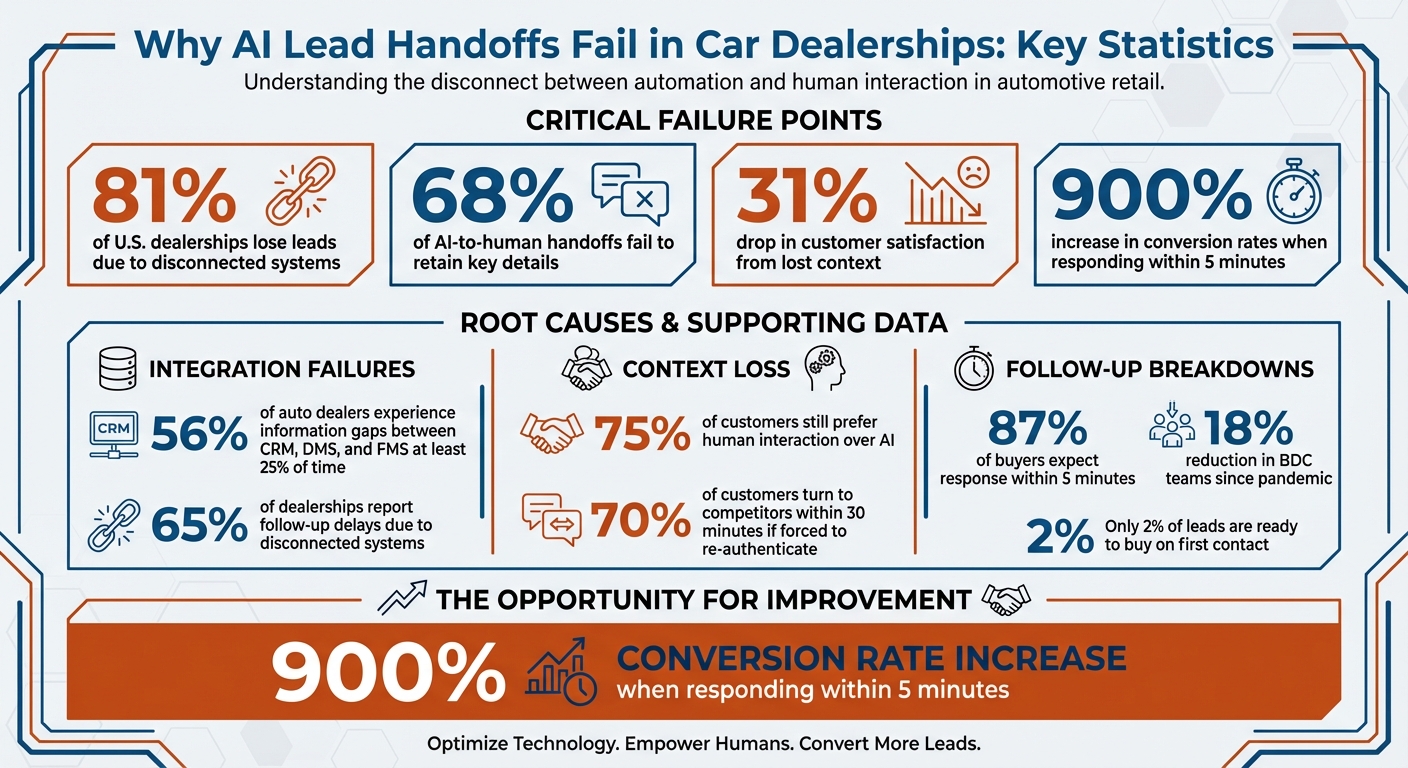 {AI Lead Handoff Failure Statistics in Car Dealerships}
:::
{AI Lead Handoff Failure Statistics in Car Dealerships}
:::
Why AI Lead Handoffs Fail
The main reason AI lead handoffs fail isn’t the technology itself - it’s the disconnection between systems that need to work together. Imagine an AI chatbot capturing a lead late at night, but your CRM doesn’t receive the data until hours later. By the time your team follows up, the lead might already be lost. These breakdowns stem from poor system integration, the AI’s inability to retain customer context, and weak follow-up processes. Let’s break down the three key problems behind these failures.
Get weekly AI strategies for your dealership
Join 2,500+ automotive professionals. No spam.
Poor Data Synchronization Between Systems
Dealerships often operate with systems that don’t integrate smoothly. Even minor mismatches - like an AI chatbot sending "Closed" instead of the CRM’s expected "closed_won" - can derail the handoff entirely. According to research, 56% of auto dealers experience information gaps between their CRM, DMS, and FMS at least 25% of the time [3].
The situation worsens when integrations rely on outdated methods like polling instead of real-time updates or when systems only allow read-only access. This prevents AI from updating lead statuses or setting up follow-up tasks automatically.
Take the example of Spyne, an automotive AI provider, which partnered with VINCUE in December 2025 to launch "Benjamin", a conversational AI assistant integrated directly into the VINCUE ecosystem. This initiative aimed to address the leaky bucket problem, where 81% of dealerships were losing leads due to disconnected systems [2].
Legacy technology adds to the problem. Complex OAuth 2.0 authentication flows often fail, causing data logging to stop without anyone noticing.
"We were astonished that so many dealerships are suffering from significant data lapses between the three major information systems - lead generation, customer management and finance - that their dealerships run on." - Pete MacInnis, Founder and CEO, eLEND Solutions [3]
Here’s a quick look at common integration failures and their impact:
| Integration Failure Point | Impact on Dealership Workflow |
|---|---|
| Polling Lag | AI sends follow-up emails on deals already closed by sales reps |
| Read-Only Access | AI qualifies leads but can’t update CRM statuses, stalling progress |
| Formatting Mismatch | API calls fail when the AI sends "Closed" instead of the required "closed_won" |
| Auth Expiry | AI stops logging activities due to an expired OAuth token |
| Rate Limiting | High lead volume overwhelms the CRM API, blocking the AI |
Fixing these integration issues is critical to making lead handoffs work seamlessly.
AI Systems Miss Customer Context
Even when the technical handoff works, AI often fails to maintain the context of the customer interaction. For example, an AI might gather detailed preferences, but if the sales rep only gets a generic summary, the finer details are lost. Research shows that 68% of bot-to-human handoffs fail to retain critical context, forcing customers to repeat themselves and reducing satisfaction by 31% [1]. Additionally, 75% of customers still prefer human interaction because AI struggles with the complexity of dealership-specific inquiries [4].
"The context the bot collected just disappears. The customer restarts the entire conversation with a different system. All the information they just provided becomes useless." - Jim Iyoob, President, ETSLabs [1]
This issue becomes worse when systems don’t share authentication states. For example, if a customer verifies their identity with the chatbot but must re-authenticate with a sales rep, 70% of those customers will turn to a competitor within 30 minutes [5].
To maintain customer trust, AI must do a better job of preserving and transferring context during handoffs.
Broken Follow-Up Processes
Even the best handoff won’t matter if the follow-up process fails. Sixty-five percent of dealerships report delays in customer follow-ups due to disconnected CRM and chat systems [2]. Without automated follow-up tasks that include the full conversation history, the BDC team is left scrambling to piece together fragmented information.
Most leads aren’t ready to buy on the first contact - only 2% are. Without a structured follow-up timeline - like automated reminders on Day 2, personalized calls on Day 5, and re-engagement on Day 30 - the other 98% of leads can slip away. This challenge is harder to manage with BDC teams reduced by about 18% since the pandemic [2].
Technical delays, such as slow screen pops that hold up lead details, further disrupt the process. And while responding within 5 minutes can boost conversion rates by 900% [6], this advantage is only possible when follow-up workflows run smoothly.
Streamlining follow-up processes ensures no lead is left behind.
How to Fix AI Lead Handoffs
Fixing AI lead handoffs requires addressing gaps in system integration, ownership of processes, and follow-up accountability. The solutions below tackle common problems like integration breakdowns, missing context, and poor follow-up practices. These steps help create a system where every lead is properly tracked and handed off for timely follow-up.
Fix CRM Integration Issues
Eliminate technical barriers that prevent AI from updating your CRM in real time. Avoid polling-based integrations that delay data updates. Instead, opt for real-time API connections to ensure lead information is pushed into your CRM immediately. If your current CRM only supports read-only access, escalate the issue with your vendor or consider switching to a platform that supports bidirectional data flow.
Another frequent issue is field mapping errors. For example, if your AI sends "Closed" but your CRM expects "closed_won", the handoff fails. Collaborate with your AI vendor to ensure all fields are mapped correctly before going live. Native integrations often reduce the fragmentation that leads to lost data across disconnected systems.
Make sure your CRM provides mobile access to AI-generated lead histories. This allows salespeople to review lead summaries while on the lot or between appointments, keeping them informed and prepared [7].
Use Warm Handoff Methods
Ensure the handoff process includes full context and clear next steps for the sales team. A warm handoff means the AI doesn’t just assign a lead to a queue - it passes it to a human with all relevant details, clear actions to take, and confirmation that the handoff was completed. This eliminates the risk of leads sitting unassigned in a "black hole."
Leverage AI to condense conversation details into short, actionable summaries for your sales team. Instead of making a BDC agent sift through long chat logs, the AI should highlight key information like the customer’s vehicle of interest, trade-in details, preferred contact times, and any objections raised [7]. These summaries should appear directly in the CRM.
Set up real-time alerts to notify salespeople immediately when a high-intent lead is assigned to them. Alerts via SMS, email, or push notifications prompt faster follow-up, and responding within five minutes can boost conversion rates by up to 900% [6].
Use AI tools that boost sales performance to prioritize shoppers who are ready to buy. If the AI detects strong signals of intent, such as scheduling a test drive or asking detailed pricing questions, mark the lead as "hot" and route it to a top salesperson. This ensures high-priority leads don’t get lost in a general queue [6].
"If the question is more complex or if a buyer is ready to schedule a test drive, the conversation is handed off to a salesperson with the full chat history included. There is no friction, no confusion, and no missed handoff." - Selly Automotive [7]
Improve AI Context Recognition
Lost information is a major reason follow-ups fail. To fix this, train your AI to capture and log critical customer details that are key to your sales process. This includes trade-in specifics like year, make, model, mileage, VIN, as well as financing preferences and appointment scheduling.
Your AI should also track behavioral signals, such as repeat visits to your website or test drive bookings, and add this data to the lead profile in your CRM [6]. Use a unified customer profile system that consolidates all AI interactions, chat history, and behavioral data. This gives salespeople a complete view of the customer’s journey when they engage [6].
Ensure your AI has access to live data from your DMS, recall database, and scheduler. Without real-time inventory and appointment availability, the AI operates without key context [8].
"If the AI can't pull from your data - DMS, recall database, scheduler - then it's just guessing in the dark." - Chris, Founding Marketing Lead, Toma [8]
How to Measure Handoff Performance
Tracking what happens after a lead handoff is just as important as monitoring lead volume. Many dealerships miss this step, leading to lost revenue opportunities. To evaluate the effectiveness of your AI-driven lead handoffs, focus on metrics that highlight process breakdowns and uncover revenue leaks.
Track These Key Metrics
Start with lead response time. This measures how quickly your team reaches out to a lead after the handoff. Research shows that 87% of buyers expect a response within 5 minutes, and every minute beyond that reduces your chances of closing the sale by 8% [11].
Next, monitor both the appointment set rate and the appointment show rate. The set rate tells you how many contacted leads result in scheduled appointments. Meanwhile, the show rate - typically between 50% and 65% [10] - shows how many of those appointments turn into actual visits. A low show rate often points to issues with follow-up or appointment confirmation strategies.
Another critical metric is the handoff success rate. This measures how smoothly leads transition from AI to human agents. Poorly managed handoffs can cause up to 56% of leads to fall through the cracks [12]. Keeping track of how many leads are contacted by a salesperson within the first hour can help identify bottlenecks, like leads sitting idle in queues.
The lead-to-contact ratio is also key. This metric shows how many qualified leads turn into real conversations. If qualified leads aren’t being contacted consistently, the issue likely lies in your process, not the lead quality [10].
Finally, measure the close rate on BDC-influenced leads to directly tie AI activity to revenue. For example, Freeman Lexus saw impressive results when they implemented an AI BDC platform in September 2025. The system managed roughly 1,100 service calls, creating 426 bookable opportunities and securing 376 appointments - a booking success rate of 88%. This translated into an estimated monthly profit impact of $100,000 [12].
"Strong BDC performance comes down to visibility. When automotive BDC metrics like response time, lead-to-appointment ratios, and close rates are tracked consistently, gaps surface quickly." - Spyne.ai [10]
These metrics help pinpoint where the process breaks down. While AI may effectively capture leads, human accountability often falters in follow-up or handoff execution. Tracking and analyzing these numbers ensures you can identify and address the weak links.
Compare Results Before and After Changes
To measure the impact of process improvements, start by collecting 30 days of CRM data to establish a baseline. Focus on metrics like response time, appointment set rate, and show rate [11]. Without this initial data, it’s impossible to gauge progress.
Once changes are implemented - such as fixing CRM integration issues, adopting warm handoff methods, or improving AI’s ability to provide context - pull the same metrics again and compare. For example, if your response time drops from 47 minutes to 8 minutes and your contact rate jumps from 40% to 72%, you have clear evidence that the adjustments worked. If results remain stagnant, it’s time to reevaluate where the problem lies.
Bay Area CDJR offers a compelling example. After introducing an AI communications platform, they saw service appointments increase from 205 to 448 in just 30 days. The AI booked 304 of those appointments, contributing to an estimated $83,000 profit boost in the first month alone [12]. These results show how refining the handoff process can directly enhance performance.
Real-time dashboards are another essential tool. They allow you to spot and fix handoff failures the same day they occur, rather than letting issues linger for weeks [10].
Next Steps for Your Dealership
Losing revenue on qualified leads isn’t about technology - it’s about broken processes. Start by streamlining your tech stack. When your CRM, chat, and inventory systems don’t communicate, leads disappear into the cracks [2]. Opt for unified platforms where AI, CRM, and inventory data work together seamlessly. This ensures every lead moves smoothly through your pipeline.
Next, assign clear responsibility for overseeing AI performance. Make someone - like your BDC manager or sales director - accountable for monitoring AI dashboards, spotting handoff issues, and ensuring vital information gets to your sales team [9]. Without someone in charge, AI-generated leads will sit idle while your team wastes time on lower-priority prospects. Once ownership is set, focus on improving first contact rates.
Implement a 5-minute response rule. Pair instant AI replies with quick staff follow-ups to drive a 900% increase in conversion rates [6][9]. Use real-time SMS or email alerts to flag high-value leads so your team can act immediately.
Lastly, track what happens after leads are handed off. Set a 30-day benchmark and compare metrics like response times, appointment show rates, and close rates after making adjustments. If show rates don’t climb, the issue isn’t the AI - it’s the follow-up process, staff training, or accountability framework. Fixing those gaps will unlock better results.
FAQs
::: faq
How can car dealerships ensure smoother AI-to-human lead handoffs?
Car dealerships can strengthen AI-to-human lead handoffs by implementing a clear, structured process that ensures every lead is handled with care. Start by marking AI-qualified leads clearly in your CRM. This makes it easier for sales staff to spot and prioritize them. Training your team is equally important - ensure they know how to review AI-generated notes, follow up quickly, and confirm appointments without delay.
To avoid mistakes, assign ownership for each lead and track follow-up actions closely. This approach reduces the risk of leads slipping through the cracks. Regularly auditing the handoff process can uncover weak spots, such as missed follow-ups or unassigned leads, giving you the chance to fix them. By combining well-defined workflows, team training, and ongoing oversight, dealerships can use AI to boost lead conversions and grow revenue. :::
::: faq
What challenges arise when integrating AI systems with dealership CRMs?
Integrating AI systems with dealership CRMs can hit a few snags. Common issues include data silos, workflow mismatches, and poorly tagged leads. When AI-generated leads aren’t flagged or prioritized correctly in the CRM, it becomes harder for staff to identify them. This confusion often results in missed sales opportunities.
Another hurdle is unclear ownership. Without clear processes, AI leads can end up sitting idle - unassigned or ignored. This problem worsens if staff don’t trust or know how to handle AI-generated data. On top of that, outdated CRM information can throw off AI predictions, leading to inaccurate insights and weak follow-ups.
To sidestep these challenges, dealerships need thoughtful integrations. Focus on maintaining consistent data, smooth workflows, and defined accountability for managing AI-driven leads. :::
::: faq
Why is it important to respond to leads quickly in car dealerships?
Responding to leads quickly isn’t just important - it’s a game-changer. Research shows that getting back to potential buyers within 5 minutes can increase your chances of making contact by up to 900%. That’s not just a small edge; it’s a massive advantage when it comes to closing deals.
Quick follow-ups also send a strong message. They show that your dealership is responsive and prioritizes customers, which helps build trust. And trust matters - especially when 78% of buyers end up purchasing from the first dealership that responds. In a competitive market, every minute counts. Slow responses? They’re essentially leaving money on the table. :::