

A 3-person BDC does not cost what shows up in the payroll column. By the time you add benefits, manager oversight, software, turnover, vacancy gaps, and the leads that age out before anyone touches them, the real annual number is usually closer to $180K-$300K per rooftop. That is the number a GM should use when deciding whether the BDC is creating capacity or just hiding leakage.
Key Takeaways
- A 3-person BDC is a fixed-cost department attached to variable lead flow.
- The visible cost is salary; the hidden cost is missed response, slow follow-up, and duplicated admin work.
- The 391% chart is a speed-to-lead benchmark: contacting a lead inside 60 seconds can massively outperform waiting several minutes, but it is not a guaranteed close-rate promise.
- Automation works best when it removes clerical touches and leaves humans on complex deals.
- The right question is not "Do we need a BDC?" It is "Which BDC tasks still need a human?"
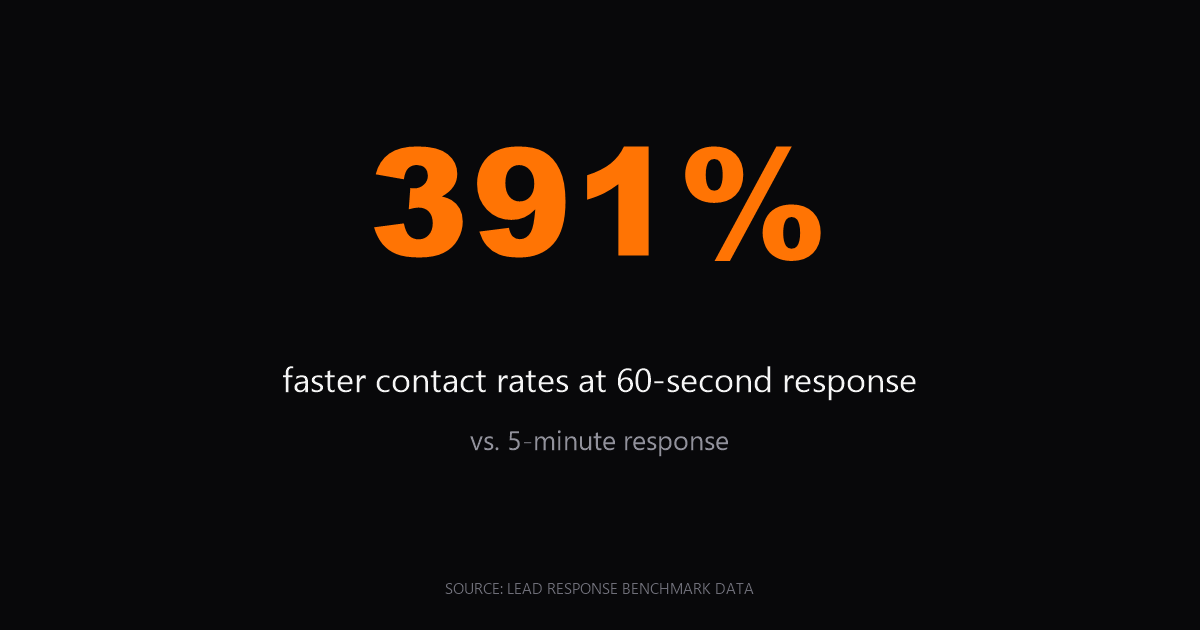
The 391% figure is a response-time lift, not a magic revenue guarantee. It compares ultra-fast first contact against a slower response window. The practical point for dealers is simple: the first minute is not the same as the fifth minute. A shopper who gets an immediate, useful reply is still in the buying moment; a shopper who waits is usually opening other dealer tabs.
What Does a 3-Person BDC Really Cost?
Start with the obvious line item. Three BDC reps at $45K-$55K each put base payroll around $135K-$165K before taxes, benefits, PTO, recruiting, training, manager time, phone tools, texting tools, CRM seats, QA, and churn. Add those loads and the planning range moves fast.
That is why $180K-$300K per year is the useful operating range. A lean single-point store may sit near the lower end. A metro rooftop with higher comp, turnover, and a dedicated BDC manager can land closer to the upper end. Either way, the BDC is not a cheap function. It is a capital allocation decision.
Cox Automotive's CRM guidance makes the same operational point from a different angle: follow-up quality depends on clean customer records, connected inventory context, and consistent process, not just more people typing into a CRM (Cox Automotive CRM 101).
Get weekly AI strategies for your dealership
Join 2,500+ automotive professionals. No spam.
Where Does the Waste Usually Show Up?
The first leak is response time. If the BDC is staffed nine to six, Monday to Friday, every evening lead and Sunday lead starts life behind. A store can have good reps and still lose because the coverage model is wrong.
The second leak is duplicated admin. BDC reps spend too much of the day acknowledging leads, confirming appointments, copying stock numbers, checking inventory, and sending basic status updates. Those touches matter, but they do not all require a trained human.
The third leak is unworked demand. Pied Piper's Internet Lead Effectiveness research has repeatedly shown that dealer response quality varies widely by brand and rooftop, with some stores still failing to provide strong personal responses to website customers (Pied Piper 2024 ILE study).
Why Does 60 Seconds Matter More Than Five Minutes?
Dealers often treat "inside five minutes" as fast. The buyer does not. The buyer is already comparing listings, payment ranges, and trade values across multiple tabs.
The old benchmark was speed. The new benchmark is speed with context. A reply inside 60 seconds only matters if it answers the actual lead: the vehicle, the appointment, the trade, the payment question, or the next action. A fast generic autoresponder still feels like a stall, which is why first-touch speed has to be measured alongside first-contact quality.
That is why the 391% chart should be read carefully. It supports a direction: faster first contact improves the odds of reaching the shopper. It does not mean every dealer will get a 391% sales lift. The number is useful because it forces the right operational question: can your store respond while the buyer is still active?
How Should Text, Phone, and CRM Work Together?
Text should win the first touch when the customer starts digitally. It is fast, visible, and easier to answer during work hours. Phone still matters once intent rises: trade appraisal, payment objection, F&I question, appointment confirmation.
The better model is not "replace calls with text." It is text first, call when the conversation earns it. Cox Automotive's digital retailing research points to the same broader trend: dealers and buyers both benefit when online and in-store steps connect cleanly instead of forcing the buyer to restart the process (Cox Automotive digital retailing study).
What BDC Tasks Should Still Be Human?
Keep humans on conversations where judgment changes the outcome:
- Trade objections
- Negative equity
- Payment sensitivity
- Complex finance questions
- Multi-vehicle household decisions
- High-intent phone calls
- Appointment save attempts
Automate the work that is repetitive, rules-based, and time-sensitive:
- First response
- Appointment confirmation
- Inventory-aware replies
- Price-drop reactivation
- No-show recovery
- Long-tail CRM nurture
- After-hours capture
That split is where the economics improve. You are not paying humans less because they are less valuable. You are protecting their time for the moments where they are actually valuable, which is the practical version of AI transforming dealership jobs instead of simply replacing them.
Want to know whether your BDC is creating margin or hiding leakage? Run the Speed-to-Lead calculator and compare your current response time against a sub-60-second process.
What Is the Right Decision: Replace, Augment, or Hybrid?
Most stores should not start with full replacement. They should start with task separation.
If your BDC has strong closers, keep them. Put automation underneath them so they are not buried in first-touch admin and CRM reminders.
If your BDC is mostly logging activity without improving contact rate, replacement or heavy automation belongs on the table. A team that cannot respond quickly, consistently, and across channels is not a sales asset. It is a payroll line with a sales label.
For many rooftops, the answer is hybrid: one or two humans for high-intent conversations, with automation handling the immediate response layer, after-hours coverage, routine follow-up, and aged-lead triggers.
What Should a GM Audit This Week?
Pull five numbers before adding another BDC seat:
- Fully loaded BDC cost, including benefits, manager load, tools, recruiting, and turnover.
- Median first-response time by lead source.
- Percentage of leads contacted inside 60 seconds, five minutes, and 15 minutes.
- Percentage of leads with no human or automated response after 24 hours.
- Appointment rate by response-time bucket.
Those numbers will tell you whether the BDC is a capacity engine or a leak. If the team is fast, consistent, and focused on real conversations, automation should augment it. If the team is slow, reactive, and buried in clerical touches, the operating model needs to change.
Frequently Asked Questions
What is the real cost of a 3-person BDC?
A practical planning range is $180K-$300K per year per rooftop once salary, benefits, management time, software, turnover, and unworked leads are included.
Does automation mean replacing the whole BDC?
Not usually. The strongest model is often hybrid: automation handles first response and routine follow-up, while humans handle complex, high-intent conversations.
Why does speed-to-lead matter so much?
Because the buyer is still active when the lead first arrives. A useful response inside the first minute reaches the shopper before they move to the next dealer.
Should dealers use text or phone first?
Use text first when the lead starts digitally, then move to phone when the conversation becomes complex or high-intent. The channel should match the buyer's stage.
What should a GM measure before changing the BDC?
Measure fully loaded cost, median response time, 60-second response rate, no-response rate, appointment rate, and sold units by response-time bucket.