In this article
The Bottom Line: 76% of dealers are increasing AI budgets in 2026. But most still can't answer "what's the ROI?" Here's what the data actually shows after 90 days — the wins, the misses, and a simple formula to calculate it yourself.
The State of Play
The automotive industry has shifted from asking "should we use AI?" to "which AI should we buy?" According to Spyne's 2026 U.S. Automotive Market Sentiment Report — based on a survey of nearly 1,200 dealership leaders — 76% plan to increase their AI budgets this year.
But here's the disconnect: while enthusiasm is high, clarity on ROI remains low.
- 74% of dealers cite AI voice agents as their #1 investment priority
- 74% also worry about AI accuracy (Cox Automotive)
- 66% want better education on what AI can realistically do
- 95% believe AI is critical to future success, yet many can't quantify the return
The gap between "we need AI" and "here's what AI actually delivered" is where most dealerships get stuck.
The Hard Numbers: What Dealers Are Actually Seeing
Let's cut through the vendor pitch decks. Here's what third-party research shows about dealership AI performance after 90 days of implementation:
Lead Response & Conversion
| Metric | Before AI | After AI (90 days) | Change | Source |
|---|---|---|---|---|
| Lead response time | 6.2 hours | 52 seconds | -99.2% | AutoRaptor 2026 |
| Lead conversion rate | 8.7% | 13.4% | +54% | AutoRaptor 2026 |
| Missed calls | 33% (~154/mo) | Near zero | -100% | CDK Global |
| Cost per acquisition | $723 | $447 | -38% | AutoRaptor 2026 |
Operational Efficiency
| Metric | Before AI | After AI (90 days) | Change | Source |
|---|---|---|---|---|
| BDC operating costs | Baseline | -33% | Significant | Spyne 2026 |
| Showroom appointments | Baseline | +25-30% | Significant | Spyne 2026 |
| Online listing engagement | Baseline | +67% | Major lift | Spyne 2026 |
| Ops time saved | — | 12-15 hrs/week | Direct savings | Spyne 2026 |
| Marketing team hours/week | 42 | 26 | -38% | AutoRaptor 2026 |
| Campaigns deployed/month | 3 | 11 | +267% | AutoRaptor 2026 |
Revenue Impact
100% of dealerships that have implemented AI reported revenue increases over the past year, according to FullPath's AI Sentiment Report:
- 37% saw a 20-30% revenue increase
- 19% saw a 10-20% increase
- 18% reported over 30% growth
- 26% saw a more modest 1-10% lift
- 0% reported no contribution or a decrease
That last data point matters: not a single dealership reported that AI hurt their revenue.
Named Case Studies: Real Stores, Real Results
Middletown Honda
AI handled over 50% of inbound calls end-to-end. Result: saved over $100,000 annually by eliminating extra phone coverage staff.
Martin Management Group
Automated 22,000+ calls across 13 rooftops in 90 days. Result: doubled operational margins and scheduled over $2M in service appointments.
Vaughan Automotive
Generated 1,200 additional service appointments and $225K in repair orders in one month across four stores.
Single CDJR Store
Service appointments jumped from 205 to 448 monthly in the first month with AI — achieving zero missed calls.
The "60% Rule"
According to DealershipGuy's analysis, properly customized AI is driving 60%+ increases in call answer rates and 80% increases in booked appointments when dealers engage deeply with configuration.
The Simple ROI Formula
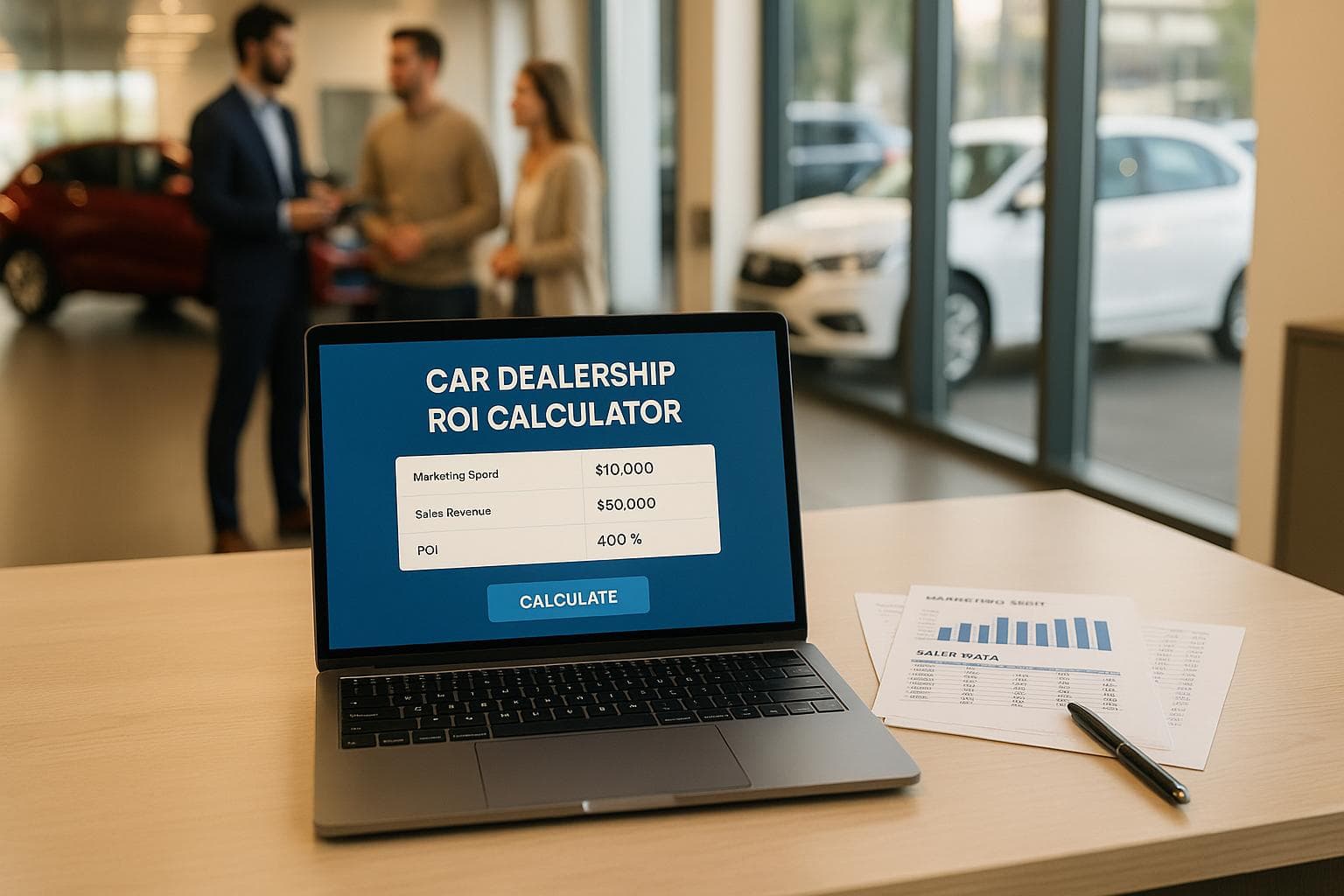
Stop guessing. Here's how to calculate your AI ROI with your own numbers:
Revenue Recovered (Missed Calls)
| Input | Your Number | Example |
|---|---|---|
| Missed/abandoned calls per month | _____ | 400 |
| Percent with sales or service intent | _____ | 60% |
| AI answer rate | _____ | 95% |
| Calls now captured | _____ | 228 |
| Appointment booking rate | _____ | 25% |
| New appointments per month | _____ | 57 |
| Show rate | _____ | 65% |
| Close rate from shown | _____ | 40% |
| Average gross per sold unit | _____ | $3,500 |
| Additional gross per month | _____ | ~$52,500 |
Revenue Recovered (Lead Reactivation)
| Input | Your Number | Example |
|---|---|---|
| Unsold leads aged 30-90 days | _____ | 500 |
| AI reactivation contact rate | _____ | 35% |
| Appointment set rate | _____ | 15% |
| Show rate | _____ | 55% |
| Close rate | _____ | 30% |
| Additional units per month | _____ | ~4 |
| Additional gross per month | _____ | ~$14,000 |
Cost Avoided
| Category | Monthly Savings |
|---|---|
| Reduced BDC overtime/overflow staffing | $3,000 - $8,000 |
| Lower turnover-related ramp and rehire costs | $2,000 - $5,000 |
| Reduced manager coaching and QA time | $1,500 - $3,000 |
The Formula
Monthly AI ROI = (Revenue Recovered + Cost Avoided - AI Platform Cost) / AI Platform Cost
For most stores, the math works within 30-60 days if you start with a workflow close to revenue (calls, follow-up) rather than one that's operationally useful but hard to monetize.
Where AI Fails (And How to Avoid It)
Not every AI deployment succeeds. Here's what the data says about common failure modes:
1. Out-of-the-box implementations
"Out-of-the-box AI implementations are failing at dealerships. Dealers who assume AI will just plug in and solve everything tend to see poor results." — DealershipGuy vendor analysis
2. One generic agent for everything
Sales and service have different customer intents, different scripts, and different priorities. One generic configuration underperforms for both teams. Configure separately by department.
3. No human oversight
AI is a coverage and consistency layer around your team, not a replacement for skilled people. The strongest model is hybrid: AI handles speed and consistency, humans handle complexity and relationships.
4. Starting with the wrong workflow
Start near revenue (missed calls, lead follow-up), not near "nice to have" (internal process automation). The ROI is clearest when you can tie AI directly to appointments and sales.
5. Expecting instant results without tuning
Treat AI like a new employee who needs proper onboarding. Customization to your dealership's voice, inventory, and processes is what separates 60%+ improvement from disappointment.
The 90-Day Playbook
Based on what's working at high-performing dealerships:
Days 1-30: Prove It Works
- Pick ONE high-leakage workflow (missed calls or after-hours coverage)
- Set baseline metrics before turning on AI
- Focus on configuration and tuning, not scaling
Days 31-60: Measure and Optimize
- Review transcripts and appointment outcomes weekly
- Tune scripts and responses based on real call data
- Calculate first ROI using the formula above
Days 61-90: Expand
- Add second department (service if you started with sales, or vice versa)
- Begin lead reactivation campaigns
- Set up ongoing QA review cadence
What to Measure: The KPI Checklist
Track these weekly, not monthly:
Revenue Metrics:
- Call-to-appointment conversion rate
- Appointment show rate
- Revenue per repair order (service)
- Lead-to-sale conversion rate
- Cost per acquisition
Efficiency Metrics:
- Call answer rate (target: 95%+)
- Average response time (target: under 60 seconds)
- Staff hours saved per week
- Manager oversight hours reduced
Quality Metrics:
- Customer satisfaction scores
- Containment rate (calls resolved without human transfer)
- Booking accuracy (appointments that match availability)
The Bottom Line
The data is clear: AI delivers measurable ROI for dealerships within 90 days when implemented correctly. The performance gap between AI-enabled dealers and manual operators isn't linear — it widens quickly.
With projected 25% reductions in profit per vehicle retailed in 2026, dealerships can no longer absorb process inefficiencies. The question isn't whether to adopt AI. It's how fast you can implement it without repeating the mistakes that trip up most dealers.
Start with one workflow. Measure everything. Expand what works.
Ready to see what AI can do for your dealership? Book a strategy call and we'll walk through the ROI calculation with your actual numbers.
Filed underAIROIDealership Operations

Written by the VisQuanta team
The people who build and run the Agentic Ecosystem for automotive businesses: lead response, reactivation, calls, reviews and chat, checked by a human on every account.