
The problem with running five front doors
A single dealership already has too many places for a customer to disappear.
Web leads arrive from OEM sites, third-party marketplaces, Facebook lead ads, the dealership website, chat widgets, trade tools, phone calls, and service follow-up. Some arrive during business hours. Many do not. Some need a price. Some need a callback. Some are ready to buy, but only if the store responds before the next dealer does.
Now multiply that by five rooftops.
That was the operating problem for an Oklahoma dealer group. The group ran five Chevrolet and Ford rooftops across Norman, Oklahoma City, and Tulsa. Each store had its own lead flow, inboxes, website traffic, chats, appointment requests, and follow-up needs.
The group did not need a more complicated process. It needed one consistent response system that could work across every rooftop without forcing the BDC to manually hold the whole machine together.
Over a 60-day window, that system produced $1,295,924 in attributed vehicle sales revenue.
Get weekly AI strategies for your dealership
Join 2,500+ automotive professionals. No spam.
The operating setup
The group deployed VisQuanta's always-on AI agent system across all five rooftops.
The goal was not to replace the sales team. The goal was to remove the lag between customer intent and dealership response.
The system worked across three layers:
- Instant speed-to-lead. Inbound leads from OEM websites, Cars.com, AutoTrader, CARFAX, Edmunds, Facebook lead ads, and dealership chat widgets were answered within seconds.
- Database reactivation. Dormant CRM contacts were re-engaged with personalized campaigns instead of being left for occasional manual follow-up. In the 60-day window, the DBR layer worked 132 old CRM contacts and produced 3 confirmed sales worth $67,285 in attributed revenue.
- Multi-agent rooftop coverage. Each store had a named AI agent matched to that rooftop, while the group shared the same underlying response system, routing logic, and performance visibility.
That last point matters. Multi-rooftop operations often fail because each store develops a slightly different version of the process. One rooftop responds quickly. Another gets backed up. One manager watches chat. Another relies on the BDC. One store treats database reactivation as a weekly discipline. Another only touches old opportunities when traffic slows down.
The AI layer gave the group a common operating standard across five different front doors.
The 60-day result
Across the 60-day window from February 10 through April 9, 2026, the group produced:
| Metric | Result |
|---|---|
| Attributed vehicle sales revenue | $1,295,924 |
| Confirmed sales | 37 |
| AI-handled customer contacts | 2,059 |
| Database reactivation contacts | 132 |
| DBR attributed sales revenue | $67,285 |
| Average transaction value | $35,025 |
| Rooftops covered | 5 |
| Performance window | 60 days |
The headline number is the revenue, but the more useful signal is the contact volume.
The AI system handled 2,059 customer contacts across leads, callbacks, appointments, live chats, and follow-ups. That is not a side project for a single coordinator. That is an operating load.
The old-lead slice mattered on its own. Database reactivation accounted for 132 of those contacts and 3 confirmed sales. These were not same-day form fills. They were existing CRM records that had fallen out of active store follow-up, including conversations with prior message history reaching back into fall 2025 before the February and March 2026 reactivation touches.
For a dealer group, the question is not whether someone on the team could work those conversations manually. The question is whether the group can guarantee that work happens consistently across every store, every day, without depending on spare capacity.
How the rooftops performed
The public version of the case study labels the rooftops as R1 through R5.
| Rooftop | Brand | Contacts | Confirmed sales | Revenue |
|---|---|---|---|---|
| R1 | Chevrolet | 393 | 10 | $398,535 |
| R2 | Chevrolet | 397 | 12 | $379,802 |
| R3 | Ford | 324 | 7 | $265,730 |
| R4 | Ford | 828 | 5 | $208,372 |
| R5 | Ford | 117 | 3 | $43,484 |
| Total | Mixed group | 2,059 | 37 | $1,295,924 |
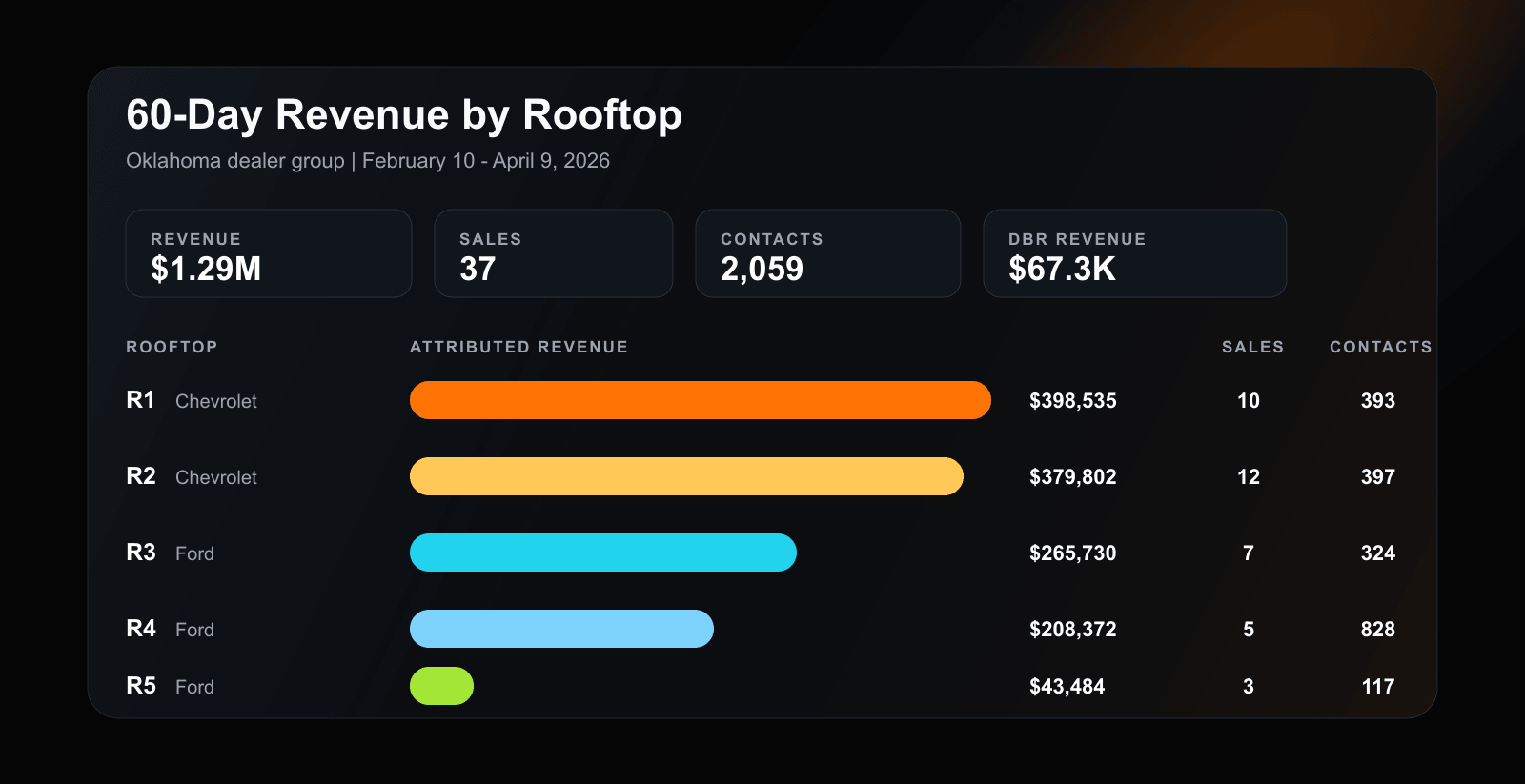
The spread is important.
This was not one store carrying the whole result. The two Chevrolet rooftops generated the largest share of revenue, but all five stores produced confirmed sales. The Ford rooftops also converted, even with different contact volume and different sales counts.
That is what makes the case useful for other dealer groups. The model did not require every rooftop to behave identically. It required every rooftop to be covered by the same response discipline.
The real bottleneck was not lead volume
Most dealers look at growth through the lens of more lead volume.
More paid search. More third-party spend. More inventory exposure. More marketplace traffic. More forms. More campaigns.
Those channels matter, but they do not solve the operating bottleneck by themselves. If a group cannot respond consistently to the leads it already receives, more volume can simply create more waste.
In this case, the group was already receiving opportunities from the channels most dealerships recognize:
- Manufacturer website forms.
- Cars.com.
- AutoTrader.
- CARFAX.
- Edmunds.
- Facebook lead ads.
- Website chat.
- Database reactivation campaigns.
The win came from tightening the response layer underneath those channels.
When every lead gets an immediate, professional reply, the store has a better chance to keep the customer in its own process. When old CRM contacts get reactivated with a specific reason to engage, the database becomes more than storage. When chat and follow-up are covered after hours, the group stops letting timing decide which opportunities survive.
That is the part most dealer groups underestimate. The CRM is usually full of people who were interested once, went quiet, and never got a relevant second pass. In this case, the AI did not treat those records as dead. It reopened them with store-specific context, routed replies back into the sales process, and turned a small DBR slice into $67,285 that would otherwise have been easy to miss.
Why multi-rooftop AI needs local context
One mistake dealer groups make with automation is treating every store like a generic endpoint.
That does not work well. Customers do not think they are talking to a corporate automation layer. They think they are talking to a specific store in a specific city about a specific vehicle, appointment, trade, or buying question.
The group solved that by using a shared system with rooftop-level personas.
Each rooftop had its own named AI agent. Customers got a consistent store-level experience, while the group still benefited from shared training, routing, reporting, and campaign management.
That structure gives a dealer group both sides of the equation:
- Local enough to feel like the store.
- Centralized enough to manage as one operating system.
For groups with multiple brands or cities, that balance matters more than the AI itself. The technology is only valuable if it respects how the dealership is actually organized.
What customers said
The platform's message archive showed the kind of responses the group was trying to create: customers continuing the conversation instead of disappearing.
One customer wrote, "You all have been very helpful. I will definitely reach out if we need anything or decide to buy again."
Another replied after purchase, "It's great! So happy we found the Robin Egg Blue. We definitely get some looks driving it around town. I love it!"
A third described the practical value of the vehicle: "It's awesome! I can now make more money with side jobs that require a truck. I am definitely a very happy camper!"
Those replies are not just testimonials. They show the difference between a lead record and an active customer relationship. The AI system did not create the dealership's inventory, pricing, or sales process. It kept the conversation alive long enough for the store to use them.
The takeaway for dealer groups
This case is not really about five rooftops in Oklahoma.
It is about what happens when a dealer group stops treating response speed, chat coverage, and CRM reactivation as separate tasks.
The group did not win because it had one magic campaign. It won because every rooftop had the same basic promise: when a customer raises a hand, the store responds quickly; when an old opportunity is worth another touch, the system does not wait for someone to remember; when conversations happen across channels, they are captured and routed instead of being left loose.
That operating consistency produced $1.29M in attributed revenue over 60 days, including $67,285 from dormant CRM reactivation alone.
For dealer principals and group operators, the question is straightforward:
How much revenue is already inside the lead flow you have, if every rooftop responded with the same discipline as your best one?
Methodology
Revenue figures are pulled from the platform's conversion-tracking database and represent confirmed vehicle sales where VisQuanta's AI agents were the primary touchpoint on the customer's path to purchase.
The performance window covered February 10 through April 9, 2026. Database reactivation figures are filtered to DBR-labeled conversion events inside the same window. Dealer names, location IDs, and store identifiers are withheld in the public version. Rooftops are labeled R1 through R5 for readability.
For industry context, this case study is informed by DAS Technology's coverage of the 2025 Lead Response Study, Foureyes' 2025 Automotive Dealer Benchmarks Report, CDK Global's study on dealership communication and financial performance, and Harvard Business Review's research on online sales lead response speed. Those sources support the broader operating context around lead handling, CRM discipline, and response consistency; the Oklahoma revenue and contact figures above come from VisQuanta's internal conversion tracking.
Frequently Asked Questions
Was this one rooftop carrying the result?
No. All five rooftops produced confirmed sales. Revenue varied by store, but the pattern held across Chevrolet and Ford locations.
What channels did the AI system cover?
The system handled manufacturer website forms, third-party marketplace leads, Facebook lead ads, website chat, callbacks, appointment follow-up, and database reactivation campaigns.
Does this replace a BDC?
No. It handles the first-response and follow-up burden so the BDC and sales team can focus on customers who are actively engaged.
Why does this matter for multi-rooftop groups?
Because the hardest part of group operations is consistency. A shared AI operating layer helps every rooftop respond quickly without forcing every store to invent its own process.