
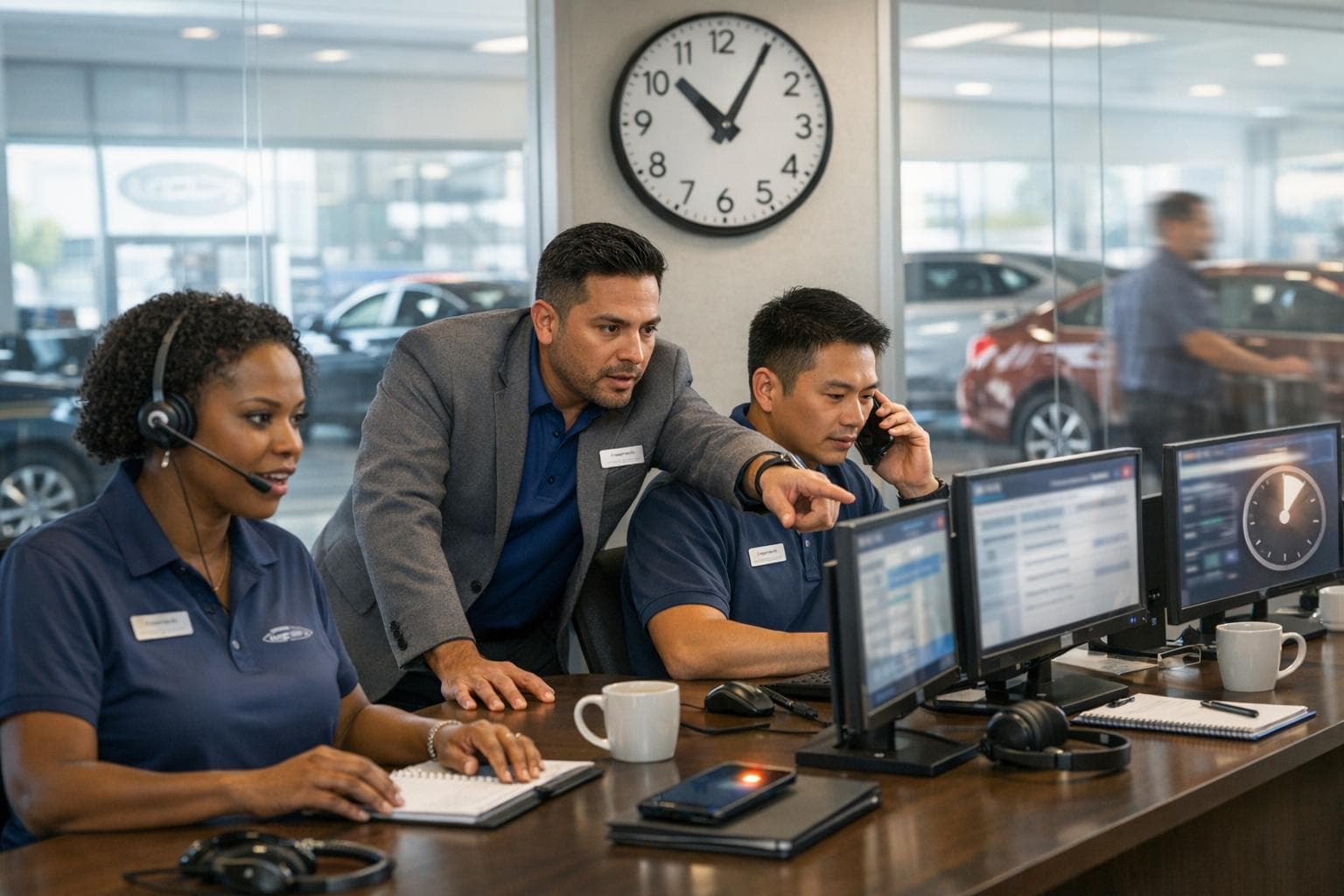
Every lead you don’t respond to within five minutes is a deal slipping away. Research shows 78% of buyers choose the dealership that responds first, and waiting even 10 minutes can slash your chances of converting by 400%. Yet, the average dealership response time is 1 hour and 38 minutes - far too slow to compete.
This article breaks down why response speed matters, how delays cost you sales, and what systems you need to reduce lead response time. If your team isn’t meeting that five-minute window - or better yet, responding in under 60 seconds - you’re losing business to faster competitors.
Let’s dive into how you can fix this and stop letting leads die in your CRM.
The Car Dealership That Cut Lead Response Time from Hours to Seconds
Why the 5-Minute Response Window Matters
::: @figure 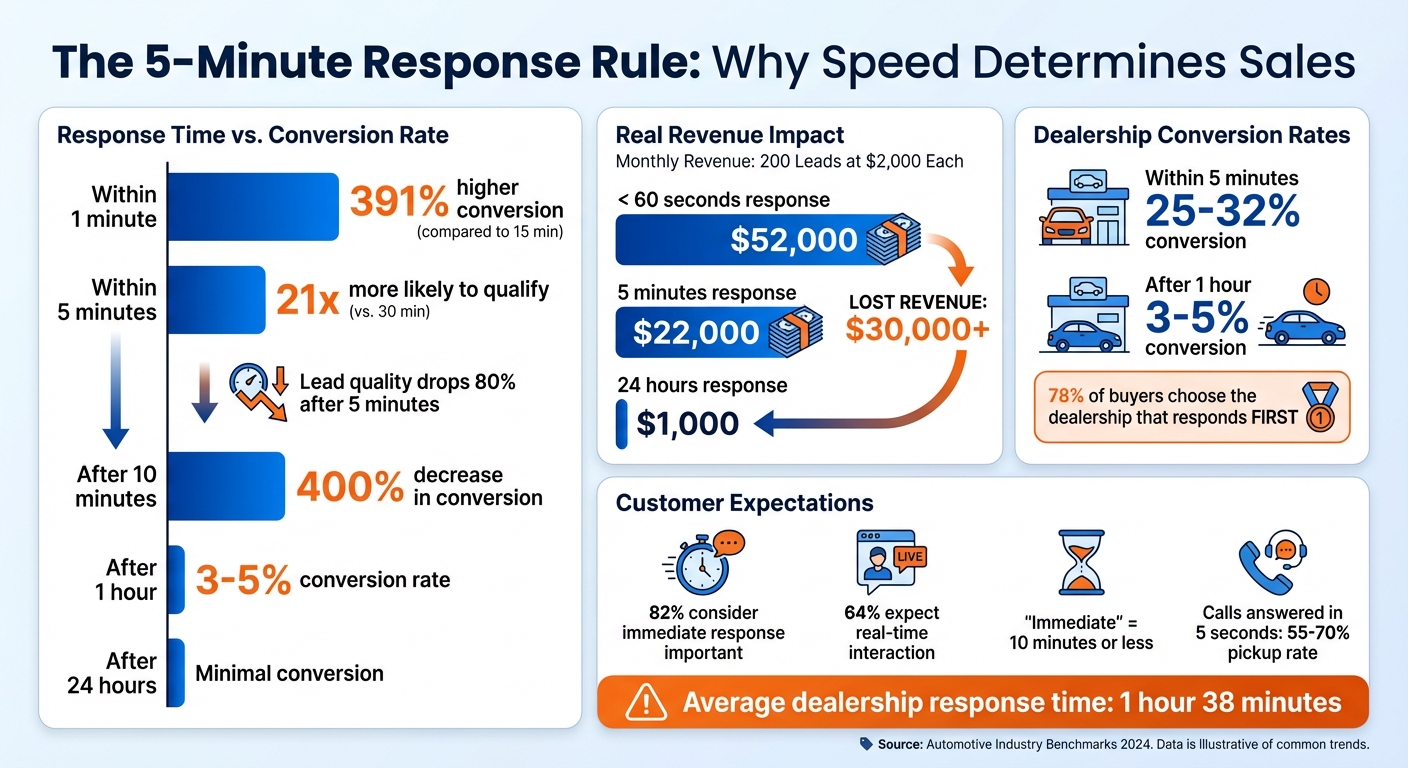 {5-Minute Lead Response Rule: Conversion Rates and Revenue Impact}
:::
{5-Minute Lead Response Rule: Conversion Rates and Revenue Impact}
:::
Research from MIT and lead response time research has cemented the importance of the "5-Minute Rule." This study highlights that the first five minutes after a lead submits an inquiry are critical for qualification. Beyond this window, the chances of converting that lead drop sharply. Let’s break down just how much is at stake.
Conversion Rates Drop After 5 Minutes
The numbers don’t lie. Leads contacted within five minutes are 21 times more likely to be qualified than those contacted after 30 minutes [3]. Even a 10-minute delay slashes your chances by 400% [5].
Get weekly AI strategies for your dealership
Join 2,500+ automotive professionals. No spam.
Dr. James Oldroyd emphasizes this urgency:
"The 5-minute rule established a decade ago was already aggressive for most sales teams. In 2026, the real competitive advantage goes to companies responding in under 60 seconds." [6]
Consider this example: A dealership managing 200 leads per month, each worth $2,000, could earn around $52,000 with sub–60-second responses. But if their response time stretches to five minutes, that figure drops to $22,000. Waiting 24 hours? Revenue dwindles to just $1,000 [3].
In the automotive world, the difference is stark. Leads contacted within five minutes convert at rates between 25% and 32%, while waiting an hour sees conversion rates crash to just 3–5% [2]. Worse still, lead quality plummets by 80% after those first five minutes [4]. These numbers show why speed isn’t just a luxury - it’s a necessity.
Modern Customers Expect Instant Responses
Fast responses aren’t just about convenience; they’re about meeting modern customer expectations. Today’s car buyers demand immediacy. Studies reveal that 82% of consumers consider an "immediate" response important or very important for sales inquiries, and 64% expect real-time interaction [5]. To many, "immediate" means 10 minutes or less [6]. Yet, many dealerships are falling short, with response times lagging behind these expectations [1].
This urgency isn’t just about being polite - it’s a competitive edge. When a lead form is submitted, the buyer is often ready and waiting, phone in hand. Calls answered within five seconds see pickup rates between 55% and 70% [3]. But as time ticks on, their intent fades. After just one hour, many potential buyers have already moved on to a competitor or resolved their need elsewhere [4].
Response speed also shapes customer perception. Buyers often judge service quality based on how quickly a company responds [4]. A fast reply says, "We’re here for you, now and after the sale." On the flip side, slow responses can erode trust and kill your chances of conversion.
These findings highlight why automation has become a game-changer in meeting customer expectations and staying competitive.
CRM Problems That Cost You Leads
Speed is everything when it comes to handling leads. Yet, 78% of automotive leads still receive their first response after 30 minutes, and 32% never get a response at all [2]. The issue isn't your team's dedication - it's outdated CRM workflows holding them back. Inefficient processes, manual tasks, and gaps during off-hours are eating away at your critical 5-minute response window. Here's where leads are slipping through the cracks.
Slow Manual Processes and Delayed Follow-Ups
Manual dialing wastes precious seconds - 30 to 60 seconds per lead, to be exact. Picture this: your rep gets a new inquiry, copies the number, dials manually, and waits for the call to connect. That small delay can mean a missed chance to engage before the conversation even starts.
Then there’s pre-call research. Spending 8+ minutes digging into a lead’s details before picking up the phone is a massive time drain [2]. As Eric Pham, Founder & CEO of Rework, explains:
"The difference between a five-minute response and a one-hour response isn't marginal - it's the difference between closing one in four leads versus one in twenty." [2]
The solution? Keep pre-call research to 60–90 seconds max [2]. Use the call itself to gather more details directly from the customer.
But delays don’t stop there - inefficient lead assignment only makes things worse.
Poor Lead Routing and Assignment
Manual lead assignment is a bottleneck. Leads often sit idle, waiting for a manager to assign them. Worse, some systems rely on batch syncing, which updates every 15 to 60 minutes instead of instantly [7]. By the time a lead is routed, it’s already gone cold.
Round-robin routing adds another layer of inefficiency. High-priority leads can end up with reps who are busy, while others are left waiting with nothing to do [7]. Without proper escalation rules, leads can sit untouched until it’s too late.
These routing issues are why 67% of franchised dealers fail to respond within the first hour [2]. It’s not about training - it’s a workflow problem.
After-Hours Leads Go Unanswered
Off-hours are a prime time for lead loss. Between 56% and 60% of leads arrive after hours [8]. Think about it: a customer submits an inquiry at 8:00 PM on a Saturday, but the lead isn’t touched until Monday morning. By then, it’s aged 36–48 hours, and the buyer has likely moved on [8].
With an average new-vehicle gross profit of $2,247 per unit [8], Every missed after-hours lead is a missed revenue opportunity, highlighting the need for a modern dealership lead generation playbook. Auto-responders promising a callback aren’t enough to keep buyers engaged [8].
Here’s the kicker: 78% of buyers go with the dealership that responds first [1]. If your store is closed Saturday afternoon through Sunday, you’re letting 30%+ of your weekly leads age overnight [2]. That’s not a staffing issue - it’s a system failure costing you deals every weekend.
Using Automation to Respond Within 5 Minutes
You don’t need a night shift to solve slow response times. Automation can step in to handle lead engagement, ensuring every inquiry gets a response within that critical 5-minute window - even when your team is off the clock. By automating key processes, you can engage leads instantly, route them efficiently, and maintain a 24/7 operation without stretching your team thin.
Instant Acknowledgment Systems
The clock starts ticking as soon as a lead enters your CRM. Automation ensures an immediate response - triggering SMS, email, or push notifications within 30 seconds of form submission [2]. This quick action pauses the customer's waiting game. Automated SMS, with its impressive 98% open rate, can kick off a two-way conversation while human reps prepare to follow up [10]. These systems can even ask qualifying questions like budget, timeline, or vehicle preferences to keep the lead engaged [9].
A proven strategy is the "Triple Threat" approach:
Send an automated SMS in the first 30 seconds.
Make a phone call within 60 seconds.
Deliver a personalized email at the same time [2].
This combination ensures leads feel acknowledged immediately, setting the stage for real-time routing to the right team member.
Real-Time Lead Routing
Manual lead assignment slows everything down. Instead, event-driven webhooks can assign leads instantly, routing them to available reps the moment they hit your CRM [10]. Simultaneous routing, which broadcasts leads to all available agents, ensures the fastest responder claims the opportunity [2]. For more specific inquiries, skills-based routing can match leads with the right expertise, eliminating unnecessary delays.
If no one claims a lead within two minutes, escalation protocols should kick in, automatically sending the lead to a supervisor or backup team [2]. This system ensures no lead gets forgotten or delayed.
24/7 Lead Response Systems
Did you know that 34% of internet leads come in after hours? Waiting until the next day to respond can cost you sales [2]. AI-powered response systems can step in to engage leads instantly, qualify them, and even book appointments through integrated scheduling tools [2]. Instead of sending a generic "we'll call you tomorrow" message, these systems can ask relevant questions, share vehicle availability, and provide self-scheduling links for test drives - all in real time [2]. This keeps customers engaged and prevents them from looking elsewhere.
Mobile CRM integration is another must-have. Push notifications ensure your sales team can respond to leads from their smartphones, no matter where they are [2]. Additionally, power dialers with local presence features - displaying a local area code instead of a generic business number - can increase answer rates by up to 40% [10].
sbb-itb-0329cfa
How to Optimize Your CRM for Faster Responses
Once automation sets the stage, your CRM must be fine-tuned for speed. While automation starts the engagement, your CRM should prioritize, assign, and track leads efficiently. The goal? Respond within that crucial five-minute window to maximize every opportunity. Let’s break down how to streamline your CRM workflows to achieve faster response times.
Setting Up Lead Prioritization Rules
Start by defining lead scoring criteria to focus on high-intent actions like live chat inquiries, returning customers, or leads with intent scores above 70 [2]. These "hot" leads should be routed simultaneously to multiple agents, letting the first available rep claim them [2]. Lower-priority leads can be distributed automatically.
Build escalation protocols into your CRM. If an agent doesn’t respond within two to three minutes, the system should reassign the lead and send alerts via SMS, email, and push notifications [2]. For after-hours inquiries, set up automated responses with self-service scheduling links - this simple step can convert 12–18% of leads [2].
Finally, monitor these changes by tracking response times and refining your process based on the data.
Measuring Response Time Performance
To improve response times, you need to measure them. Set your CRM to automatically timestamp two key moments: when the lead is created and when the first activity (call, SMS, or email) occurs [11]. This allows you to calculate the exact response gap. Break down response times into segments like 0-1, 1-5, and 5-15 minutes to identify where conversions start to drop off [11].
Track performance by lead source. For instance, Facebook leads might decay faster than website form submissions, so monitor response times and conversion rates for each channel separately [11][12]. Conduct weekly audits by creating test leads to spot any delays in your CRM [11]. Use visual cues like color-coded tags - "Hot – Call Now" or "SLA Expiring" - to help sales reps prioritize their tasks at a glance [11].
When your team sees the revenue impact of a five-minute response compared to a 30-minute one, the urgency becomes clear. These metrics not only drive faster responses but also reinforce the speed-to-lead strategy that fuels success.
Training Your Sales Team for Fast, Personal Responses
Even with instant CRM routing, sales can slip through the cracks if your team isn’t equipped to respond quickly and personally. The goal is clear: deliver a genuine, human connection within that critical five-minute window. To achieve this, your team needs to shift from a "respond today" mentality to a "respond now" approach. Let’s dive into how to improve first contact rates by ensuring every response is both timely and tailored to the customer’s needs.
Making First Contact Personal
Speed is essential, but it’s not enough without relevance. When reaching out, immediately address the customer’s specific interest - whether it’s a vehicle model, a trade-in, or a service inquiry. This shows you’re paying attention and not just sending out a generic message.
Dynamic templates with customization fields (e.g., [NAME], [YEAR], [MAKE], [MODEL]) are a great way to keep responses fast while maintaining a personal touch. Pair this with preview dialing for high-value leads. This feature lets your team review contact history and context before making the call, ensuring they’re prepared to have a meaningful conversation. And don’t underestimate the power of using the customer’s name naturally - it’s a simple way to build trust and rapport.
By blending speed with personalization, you create a foundation for integrating automation with thoughtful human interaction.
Combining Automation with Human Follow-Up
Automation can kick off the process, but your team needs to step in quickly to keep the conversation going. Think of automation as a tool to buy time, not replace the personal touch. For example, an automated text could say, "I’m pulling your trade value and availability now; I’ll call you in 10 minutes." This keeps the lead engaged while your team prepares to follow up.
Your team should be trained to seamlessly take over conversations initiated by AI agents. If automation has already gathered details like the customer’s budget or product preferences, reps should review this information before reaching out. This ensures a smooth handoff and prevents the customer from repeating themselves - a small but crucial detail that enhances the experience.
Equip your sales team with mobile CRM apps so they can respond instantly to hot leads, even when they’re not at their desks. The combination of automation and human follow-up creates a fast, personal response process that drives conversions. Every second counts, and these tools and strategies make sure your team is ready to act.
Maintaining Performance Over Time
Responding to leads within five minutes isn’t just a goal - it’s a necessity. Without regular tracking of key metrics and clear response targets, it’s easy for response times to drift. To stay on track, you need a system that monitors performance daily, holds your team accountable, and emphasizes speed as a non-negotiable priority. A well-designed CRM dashboard is the cornerstone of this process.
Using CRM Dashboards and Performance Reviews
Your CRM dashboard should provide real-time visibility into response times, highlight leads waiting longer than five minutes, and track individual agent performance. Public leaderboards can spark healthy competition by showcasing top performers.
Break down performance by lead source and time of day to identify weak spots, like slower responses during lunch breaks or shift changes. Adjust staffing or processes to close those gaps. Automated escalation rules are another must - set them to reassign leads if the first agent doesn’t respond within two minutes. This ensures no lead gets left hanging.
Use correlation reports to connect response speed with conversion rates and revenue. When your team sees how faster responses directly impact sales, it reinforces the urgency to act quickly.
Establishing Response Time Goals
Once you’ve established performance metrics, set ambitious response time goals to keep your team striving for excellence. Start with the five-minute standard but raise the bar for high-intent leads by introducing a "1-Minute Rule." Responding within 60 seconds can boost conversion rates by an astonishing 391% compared to waiting 15 minutes [13][1]. For other leads, enforce a strict five-minute SLA. Companies with formal SLAs are nearly twice as likely to respond within 15 minutes (54.9%) compared to those without one (29.5%) [11].
To measure progress, categorize response times into brackets like 0–5 minutes, 5–15 minutes, 15–30 minutes, and beyond. This helps you pinpoint where conversions drop and revenue leaks occur. Equip your team with mobile CRM tools to maintain these benchmarks, enabling push notifications for instant responses - even away from their desks.
Finally, validate your performance with quarterly mystery shopping. Submit inquiries to your own dealership and competitors to gauge how you compare in real-world scenarios [2]. These insights can reveal opportunities for improvement and keep your team sharp.
Takeaway: Respond Fast or Lose the Lead
A staggering 78% of buyers go with the first dealership that responds [1][10]. If you're not engaging leads within five minutes - or better yet, within 60 seconds - you’re handing the advantage to your competitors.
This isn't just about being polite; it's about capturing a brief moment when the buyer's interest is at its peak. The second someone clicks "submit", they’re motivated and ready to act. Any delay risks losing their attention - and their business.
These stats highlight why modern automation is no longer optional. To stay competitive, you need tools like real-time lead routing, SMS, email, and AI chatbot acknowledgments, 24/7 AI-driven engagement, and automated escalation rules. These ensure no lead waits longer than 90 seconds for a response [10]. Relying on outdated manual processes, delayed CRM syncs, or leaving leads hanging after hours can cost you serious revenue. Instead, invest in systems that route leads to your team immediately - even at night.
VisQuanta's AutoMaster Suite tackles these issues head-on. It provides a managed response system with sub-60-second engagement around the clock, AI-powered SMS lead qualification, and seamless integration of booked appointments into your system [14]. Dealerships using this approach have reported a 340% boost in booked calls and a 127% jump in scheduled appointments [14]. By responding instantly, this solution turns what could have been lost leads into closed deals.
The five-minute window is make-or-break - act fast, or lose the lead.
FAQs
::: faq
How do I measure true speed-to-lead in my CRM?
To get an accurate picture of your speed-to-lead, focus on the time between when a lead enters your CRM and when your team first responds. Use a system that timestamps both the lead's entry and the initial contact to calculate this response time. Automated dashboards can make this process easier by tracking average response times and highlighting leads that aren’t contacted within the crucial 5-minute window. This allows you to address delays and boost your lead conversion rates effectively. :::
::: faq
What’s the best way to handle after-hours leads without adding staff?
The smartest way to handle after-hours leads without adding staff is by leveraging intelligent automation tools. These tools allow you to respond instantly to inquiries, ensuring you hit the crucial 5-minute response window. By automating lead engagement during non-business hours, you can provide quick responses, maintain lead interest, and capture more revenue opportunities - all without increasing your team size. :::
::: faq
Which leads should get a 60-second response vs. a 5-minute response?
Leads should be responded to as quickly as possible - ideally within 60 seconds. Doing so can increase conversion rates by up to 391% and give the first responder a significant edge over competitors. If an instant response isn’t feasible, aim to follow up within 5 minutes to maintain a strong chance of closing the sale. Acting fast keeps opportunities from slipping away. :::