
Many dealerships are sitting on a goldmine of untapped leads in their CRMs. Instead of chasing new leads, focus on reactivating dormant ones, automating follow-ups, and converting service customers into sales. Studies show responding to leads within five minutes increases conversion rates by 21x, and re-engaging past prospects is far more cost-effective than buying fresh leads. This guide breaks down three actionable strategies to boost sales without increasing your marketing spend. Let’s dive in.
My Best Car Dealership Lead Generation Tips for 2026
::: @iframe https://www.youtube.com/embed/bmozZtM7ZQY :::
Why Traditional Lead Generation Drains Profit
Many dealerships operate under the assumption that more leads automatically translate into more sales. This belief often leads them to spend thousands each month on third-party lead providers, shelling out $10–$30 per lead that only converts at a low rate of 2–8%. Meanwhile, self-generated leads from dealership-owned tools may cost $50–$200 but convert at a much higher rate of 15–25%[2]. Focusing on sheer volume rather than quality ends up draining cash, while prioritizing higher-quality leads can significantly boost gross profit.
But acquisition cost is only part of the equation. Timing is critical. Dealerships that respond to leads within five minutes see up to a 900% increase in conversion probability[2]. On the flip side, waiting just 24 hours makes it 60 times less likely to close the deal[2]. Yet, many dealerships still rely on manual BDC processes that can’t meet these response times. Every delayed follow-up represents not just a missed opportunity but also lost revenue. Worse, these delays often sideline ready-to-buy prospects already sitting in your CRM, further compounding the issue.
The Cost of Unused CRM Data
Your CRM is a treasure trove of dormant prospects - people who showed interest in the past. These aren’t cold leads; they’re warm, familiar with your dealership and brand. reactivating these contacts costs far less than buying new leads from third-party providers. Yet, many dealerships overlook this valuable resource[1]. Instead, they continue spending on purchased leads, which are often shared with competing dealerships, reducing the odds of conversion even further[2].
This is where the Pareto Principle comes into play: 80% of your results come from 20% of your efforts[3]. While most of the leads you chase yield minimal returns, a small percentage of high-intent prospects in your CRM could drive the majority of your sales. Ignoring this reality forces you to overspend on acquisition while leaving potential revenue untouched. By concentrating on high-quality leads already in your CRM, you not only lower costs but also improve your conversion rates.
Get weekly AI strategies for your dealership
Join 2,500+ automotive professionals. No spam.
Lead Quality vs. Lead Volume
Chasing large volumes of low-quality leads wastes valuable time that could be better spent on high-intent buyers. With 83% of car buyers researching online before stepping into a dealership[2], digital leads with clear intent - such as those who’ve completed trade-in valuations or viewed vehicle detail pages (VDPs) - are far more valuable than the raw volume of third-party leads.
Additionally, CRM systems equipped with effective lead scoring and tracking can increase conversion rates by up to 30%[2]. Prioritizing lead volume clutters your DMS with low-quality contacts, skewing your metrics and driving up your cost-per-sale. This also lowers your gross profit per unit and burns out your sales team with endless follow-ups on dead-end leads. These inefficiencies highlight the need for strategic CRM reactivation and lead automation, paving the way for measurable gains in gross profit.
Strategy 1: CRM Reactivation
Your CRM is a goldmine of potential, filled with prospects who already know your dealership - whether through visits, test drives, or lead forms. These warm leads don’t cost you extra to acquire, making them a cost-effective opportunity. The key to tapping into this resource is segmentation. Start by identifying lost test-drive prospects, grouping them by model or brand interest. Then, layer in service and trade-in history, and refine further with demographics like age (25–54), income ($30,000–$90,000), and parental status. This precise segmentation ensures your leads align with the right inventory and sets the stage for focused outreach.
Segmentation for Targeted Outreach
Segmentation allows you to zero in on high-intent leads within your CRM. To gauge purchase intent and timing, use polls or simple questions to learn when your leads plan to buy and what incentives might motivate them. Successful dealerships often require their sales teams to make at least 10 calls daily to CRM-generated leads [4]. You can also cross-reference service repair orders with equity data to pinpoint trade-in candidates, helping your BDC focus on leads most likely to convert. With a refined list of high-potential prospects, your outreach can be sharper and more effective.
Personalized Messaging Frameworks
Generic follow-ups don’t cut it anymore. To stand out, every re-engagement message should follow the "Big Three" formula: offer something valuable (like a rebate or incentive), target the right audience, and create urgency. For example, you could send a message to lost test-drive prospects like this:
"Hi [Name], we just secured $2,500 in rebates on the [Model] you test-drove. Can you come in Thursday at 3 PM to lock it in before inventory moves?"
If there’s no response, shift gears with a referral request:
"Not ready yet? Do you know anyone looking for a great deal on a [Model]?"
For service customers with older vehicles, consider:
"Your [Year/Model] is due for service. This week only, we’re offering $500 over KBB on trade-ins. Interested in a quote for a new [Model]?"
You can also take inspiration from high-performing dealerships like Rusnak BMW, where Scott Smith uses structured walkthrough videos (covering Overview, Exterior, Interior, Performance, Safety, and a clear call-to-action). These videos drive engagement, often racking up 50,000 to 250,000 views per video [4].
Compliance and Legal Safeguards
Staying compliant with regulations like TCPA and CAN-SPAM is non-negotiable. Track consent meticulously across every touchpoint - CRM, DMS, website forms, and service appointments - and ensure opt-outs are logged in real time. For example, if a customer replies "STOP" to an SMS, that contact must be flagged across all communication channels.
Use ringless voicemail (RVM) as a subtle follow-up 2–4 hours after sending an initial SMS or email if there’s no reply [5]. Time your automated messages strategically - Tuesdays through Thursdays, either from 10 AM to 12 PM or 4 PM to 6 PM, tend to perform best [5]. Finally, optimize all landing pages and email templates for mobile use, as younger buyers overwhelmingly rely on their phones. Tools like VisQuanta’s AutoMaster Suite can streamline consent tracking and opt-out management across SMS, email, and RVM, keeping your campaigns compliant and efficient.
Strategy 2: Speed-to-Lead Automation
::: @figure 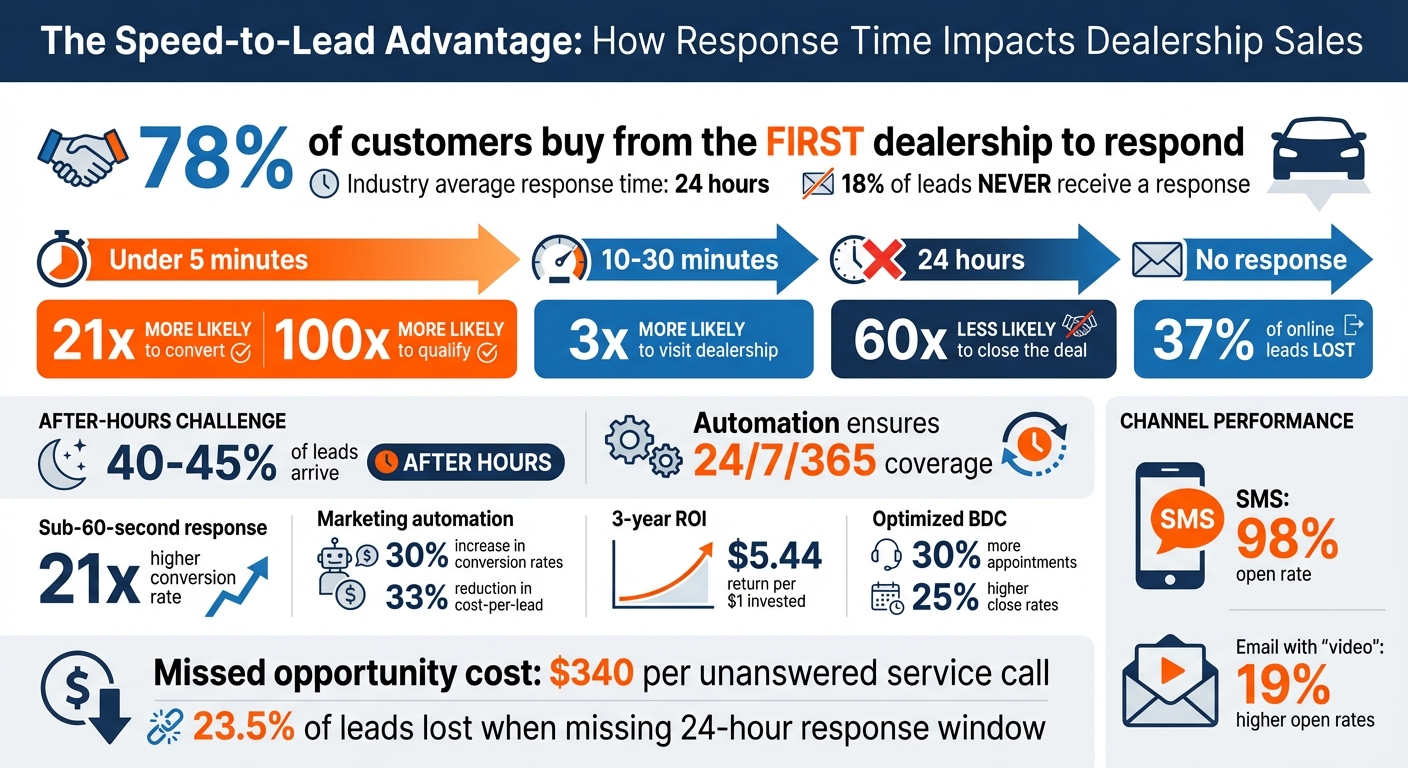 {Lead Response Time Impact on Car Dealership Conversion Rates}
:::
{Lead Response Time Impact on Car Dealership Conversion Rates}
:::
When a lead enters your CRM through digital channels, the clock starts ticking. The dealership that responds first doesn’t just get a chance at the sale - they often secure it. Research shows that 78% of customers buy from the first dealership to respond [9]. Yet, the average industry response time is a sluggish 24 hours, and 18% of leads never receive a response at all [7]. This isn’t a lead generation issue - it’s an execution issue. Let’s break down the response benchmarks that drive real conversions.
The 5-10 Minute Response Benchmark
Responding quickly to leads isn’t just good practice; it’s the key factor in closing deals [8]. Studies show that buyers are three times more likely to visit your dealership if you respond within 10 to 30 minutes [6]. But here’s the kicker: responding in under five minutes makes leads 21 times more likely to convert and 100 times more likely to qualify [10].
The challenge? 40% to 45% of all dealership leads come in after hours [7], when your sales team and BDC are unavailable. That’s where automation becomes crucial. Automated systems ensure no lead sits idle overnight. As Katherine Deighan of Covideo explains:
Your lead response sets the tone for the entire sales process [6].
A quick, personalized video or SMS acknowledgment sent within seconds keeps the lead engaged until your team can follow up the next morning.
Multi-Channel Follow-Up Protocols
Top-performing dealerships know that reaching leads requires a multi-channel approach. Combining phone, SMS, email, and video ensures maximum contact without overwhelming prospects. Start with an instant SMS, which boasts a 98% open rate [9]. This not only grabs attention but also verifies mobile numbers. From there, transition to a channel the buyer prefers. For instance, a personalized video in an email can work wonders - just including the word "video" in the subject line increases open rates by 19% [6].
The secret to making this work seamlessly? Bi-directional CRM integration. Every interaction - whether it’s a text, call, or email - should update in real time, giving your team a complete view of the lead’s history. This eliminates duplication and ensures no lead is overlooked. Tools like VisQuanta’s AutoMaster Suite handle this process automatically, providing 24/7/365 coverage even when your team is off-duty [9]. With this level of integration, your CRM becomes a sales-driving machine.
ROI Impact of Faster Response Times
The numbers don’t lie: faster response times and consistent follow-ups lead to more sales. Dealerships implementing sub-60-second response protocols achieve a 21 times higher conversion rate compared to slower responders [9]. Automation alone can boost conversion rates by 30% while cutting cost-per-lead by 33% [10]. Over three years, marketing automation delivers an average $5.44 return for every dollar invested [10].
Tracking and optimizing your BDC performance can also yield big results - up to 30% more appointments booked and 25% higher close rates [11]. On the flip side, poor follow-up execution has staggering consequences: 37% of online leads are lost, and 1 in 4 service calls goes unanswered, costing an average of $340 per missed repair order [9]. By addressing 100% of inquiries promptly, you can eliminate the 23.5% of leads typically lost when dealerships miss the 24-hour response window [10].
When every lead is captured and followed up on, the impact on your bottom line becomes impossible to ignore.
Strategy 3: Service-to-Sales Conversion
Your service drive likely sees more customer traffic than your sales floor, yet many dealerships still treat it as a cost center. Every repair order contains valuable data that can spark trade-in or upgrade conversations. Just like CRM reactivation and speed-to-lead automation, tapping into service data can transform routine interactions into opportunities for higher profits.
Using Service Data to Spot Opportunities
Integrate your CRM, DMS, and service data to build a detailed customer profile. Segment customers based on factors like vehicle make, model, year, service history, and frequency of visits. Narrow these down even further into actionable groups, such as "SUV owners due for brake inspections" or "vehicles over five years old with high mileage." Key triggers - like warranty expirations, vehicle age, or expensive repairs such as major engine work - can help you identify customers who might be ready to trade in or upgrade. For instance, someone facing a costly transmission repair on an older, high-mileage car could be an ideal candidate for a new vehicle.
Targeted maintenance reminders also make a huge difference. Emails aligned with specific needs, like seasonal maintenance or warranty-based repairs, can achieve open rates of 25–40% and click-through rates of 10–20% [12]. Even better, these timely messages can drive booking conversions up by 5–15% [12]. Compare a generic "time for service" email to one that says, "Your 2018 vehicle is due for a transmission check - let's talk about your upgrade options." The latter grabs attention and drives action.
Once you've pinpointed high-potential prospects, use this data to fuel personalized trade-in and upgrade campaigns.
Crafting Tailored Trade-In and Upgrade Campaigns
After identifying the right customers, focus on creating personalized offers that transition them from the service drive to the sales floor. Dynamic merge tags allow you to include specific vehicle details in your messaging, making it feel relevant and immediate. For example, a subject line like "Is your [Vehicle Model] ready for winter hauling?" directly speaks to pickup truck owners [12].
Use a mix of email, SMS, and push notifications to follow up and secure appointments. Smart targeting and precise messaging in the auto repair space often deliver a 3–5× return on marketing spend [12]. Industry benchmarks show auto repair email campaigns typically achieve a 25–35% open rate and a 2–5% conversion rate for service bookings [12]. Optimized campaigns don't just drive sales - they can also improve customer retention by 10–15% [12]. For customers nearing the end of their warranty or facing costly repairs, your dealership becomes the obvious solution by offering a path to a newer, more reliable vehicle.
Streamlining Appointments for Better Conversions
Once you've delivered targeted offers, make it easy for customers to move from interest to action. Simplify the jump from service to sales by automating appointment scheduling with tools like voice AI service scheduling tools and conversational platforms. Voice AI ensures customers can book service appointments 24/7, cutting down on staff workload and eliminating missed opportunities caused by busy phone lines or long hold times. Platforms like SMS and Facebook Messenger can also handle inquiries and schedule appointments automatically.
Make sure your service scheduling tool syncs with your CRM so your sales team can identify high-value trade-in prospects based on vehicle age or repair costs. Automated SMS sequences can re-engage customers who miss their service appointments, keeping future sales opportunities alive. Similarly, lease renewal sequences deployed months before a lease ends can ensure your dealership remains top-of-mind for their next purchase.
VisQuanta's AutoMaster Suite, for example, integrates directly with your CRM, giving your sales team full visibility into service history and interactions. A seamless hand-off from service to sales not only boosts conversion rates but also strengthens your dealership’s bottom line.
CRM Integration and Analytics for Lead Tracking
Once you’ve activated leads and followed up promptly, the next step is keeping tabs on their journey and analyzing the data. Why? Because without proper tracking, it’s easy to waste marketing dollars and lose sight of what’s actually driving sales. Sure, you might know you sold 15 units last month, but do you know which campaigns or strategies made those deals happen? Many dealerships pour money into third-party lead sources, Google Ads, and Facebook campaigns without a clear idea of which efforts are bringing in serious buyers versus tire-kickers. By integrating tracking tools, you connect the dots between lead capture and the conversion strategies you’ve already put in place.
Multi-Touch Attribution
Today’s car buyers rarely follow a straight path. They might browse your website, check out a Vehicle Detail Page (VDP), leave, spot a retargeting ad on Facebook, come back through organic search, and then finally submit a lead form. If your CRM only tracks the last touchpoint, you could end up giving all the credit to organic search, completely missing the role other touchpoints played in influencing the decision. Automating lead tagging at the moment of capture eliminates manual errors and ensures you see the full picture.
Break down the lead journey into clear stages: New Lead, Appointment, Test Drive, and Sold. This kind of tracking helps you spot where leads are getting stuck and which channels are moving them forward. Use tools like UTM parameters and GCLID tags on all your campaigns to measure ROI accurately. By pulling data from your website, DMS, and third-party marketplaces into a single platform, your sales team gets a complete view of each lead’s journey.
ROI Reporting by Campaign Type
Once you’ve nailed down attribution, you can take it a step further by measuring the ROI of individual campaigns. Just like personalized outreach drives conversions, detailed analytics make sure your marketing dollars are working as hard as possible. Start by tracking Cost Per Lead (CPL) and Lifetime Value (LTV) to identify the best-performing channels. Then, reallocate your budget to focus on what’s delivering the highest returns.
Monitor key metrics like lead response times, source performance, follow-up rates, and conversion rates on a weekly basis. For example, if organic search is converting better than paid ads, it might make sense to shift resources toward SEO and content marketing. Or, if platforms like CarGurus are delivering high-quality leads, increasing your inventory spend there could pay off.
VisQuanta’s AutoMaster Suite makes this process seamless. It integrates directly with your CRM, tracking every touchpoint from the initial lead all the way to the final sale - and even beyond, into service visits. Its dashboards provide multi-touch attribution and detailed ROI reporting, helping you cut underperforming campaigns and double down on what works.
"Analytics act as the compass guiding a dealership's marketing strategies, providing valuable insights into the effectiveness of lead generation efforts and enabling informed decisions that drive tangible results."
- Sean Cassy, Co-founder, Turbo Marketing Solutions [13]
Takeaways and Next Steps
Here are three smart strategies to boost revenue without inflating your marketing spend: CRM reactivation, speed-to-lead automation, and service-to-sales conversion. Your dealership's CRM and DMS are loaded with untapped potential - it's time to put them to work.
Start with a CRM audit to uncover dormant revenue. Pull leads from the past 12–24 months, including aged records, bulk uploads, and past promotions that may have been overlooked. Segment these leads by equity position, lease-end dates, and service history. Then, launch personalized campaigns with time-sensitive offers like, “Schedule this week and get a free alignment check” [14]. Make sure your outreach complies with TCPA guidelines, including proper consent and opt-out options [17].
Next, focus on speed-to-lead automation. Set up your CRM to respond to new leads within 5–10 minutes via multiple channels (phone, email, SMS) [18]. Track key engagement metrics like response rates, conversion rates, and cost-per-lead to refine your campaigns. Automate appointment reminders - send one immediately after booking and another a week before the appointment [16].
Finally, leverage service-to-sales opportunities by analyzing your service data. Identify lease-end customers three months in advance and set up automated follow-ups. For example, send post-RO messages like, “Time for your next oil change - save 10% and let’s talk upgrades.” Re-engage lapsed service customers with "We Miss You" mailers offering discounts [14][15]. Use your CRM to schedule reminders for routine service milestones like oil changes, tire rotations, and brake inspections based on vehicle history [15].
The VisQuanta AutoMaster Suite can help you execute these strategies seamlessly. It integrates with your existing CRM and DMS to reactivate dormant leads, speed up response times, and identify service-to-sales opportunities. Plus, it offers multi-touch attribution and ROI tracking to measure success. Deploy the AutoMaster Suite now to reduce lead loss and grow profits before your competitors beat you to it.
FAQs
::: faq
What are the best strategies for reactivating dormant leads in a dealership's CRM?
To bring dormant leads back to life in your CRM, focus on smart segmentation and personalized communication. Break your leads into groups based on factors like their past engagement, potential value, or how recently they interacted with your dealership. This way, your messages hit the mark and feel timely.
Leverage automation tools to handle follow-ups effortlessly. Automated workflows can kick off outreach based on specific behaviors or inactivity, keeping things consistent without overloading your team. Adding multi-channel communication - like SMS, email, and calls - can further boost response rates. Tailor your messages to align with key moments, such as seasonal promotions or personal milestones, to make them resonate.
These tactics help dealerships tap into untapped revenue, lower the cost-per-lead, and move more vehicles off the lot with less hassle. :::
::: faq
How does automating lead response times benefit car dealerships?
Responding to leads within minutes can transform how dealerships convert inquiries into sales. Research highlights that replying within 5 minutes makes you 21 times more likely to close a deal. On the flip side, waiting over 10 minutes can sharply reduce your chances of success.
Quick responses keep potential buyers engaged, reducing the risk of losing them to competitors. Automation plays a key role here, handling follow-ups and workflows seamlessly. This not only saves your team valuable time but also keeps operations running smoothly. The result? Faster responses lead to happier customers and stronger sales performance. :::
::: faq
How can dealerships use service data to boost sales?
Service data isn’t just for keeping cars on the road - it’s a treasure trove for boosting sales. By digging into service appointment records, you can pinpoint customers who might be ready for their next vehicle. Think about those nearing the end of their car’s lifecycle or hitting high-mileage marks. These are prime candidates for trade-ins or upgrades. Acting on this information turns routine maintenance visits into moments to spark new sales.
Tools like VisQuanta’s AutoMaster Suite make this process even smoother. They track customer data and enable tailored outreach through SMS, email, or calls. This isn’t just about attracting new buyers; it’s also a way to reconnect with past customers who’ve gone quiet. Timing is everything - seasonal promotions, for instance, are perfect for reactivating dormant leads.
By tapping into service data, you’re not just increasing sales; you’re doing it more efficiently. It cuts down the need for expensive new lead generation, delivering better ROI and more cars off the lot. :::