Key Takeaways
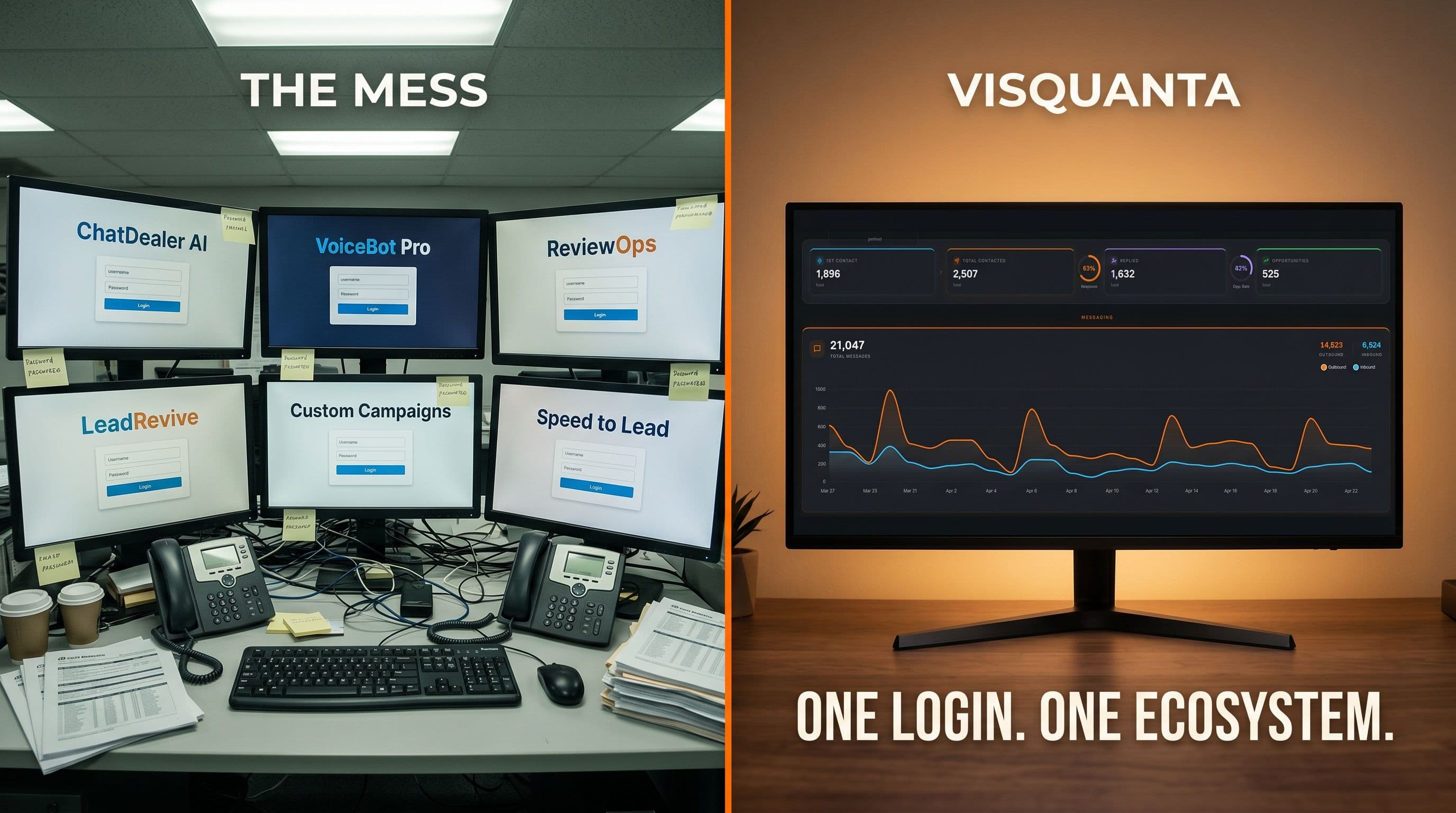
- A "unified platform" pitched to your dealership is usually five separate products behind one login — the invoice says unified, the architecture isn't.
- Your staff becomes the integration layer by default, which breaks close rate without showing up on any single system's report.
- A real ecosystem shares one customer memory, one brand voice, one management surface, and wires real handoffs between agents — not a dashboard pulling from five systems.
- AutoMaster Suite by Visquanta puts seven specialist agents under one ecosystem with the same brain, so the chat conversation on Saturday is known by the voice agent on Sunday.
- Four questions — shared memory, brand-voice location, handoff behavior, and one-timeline reporting — expose whether the vendor across the table is selling a platform or an ecosystem.
- If the answers include sync, integration, API, or dashboard, you are buying a billing wrapper. If they include shared memory and real handoffs, you are buying architecture.
47 leads, five tools, zero memory between them
The GM at a Ford store outside Tulsa opened his Monday report and saw 47 leads had come in over the weekend. Twenty-nine had chatted with the website after hours. Eleven had called the dealership and hit voicemail. Seven had texted the showroom's number. His closing rate on the month was down four points.
Every one of those 47 conversations happened on a different tool. Each one had been sold to him as "best-in-class." Each one lived behind its own login. And not one of them talked to the next.
A woman on the lot that morning had asked about a Maverick on the chat widget Saturday night — had already quoted her trade-in, a down payment, and a target monthly. The voice agent that called her back Sunday didn't know any of it. Asked her what she was driving. By the time she walked onto the lot at 10:14 Monday morning, she told the salesman she'd "already been through all this twice" and left.
That's not a bad salesman. That's not a broken chat widget. That's five tools, five logins, and zero memory between them — and the monthly invoice calls the whole stack a "unified AI platform."
The pitch that landed you here looked identical to the other four
Every GM has sat through the same meeting. A rep walks in with a slide deck, a laptop, and 20 minutes to explain why their platform is different. There's a dashboard screenshot. There's a number — usually between 8 and 15 percent — that's supposed to be the revenue lift. There's a case study from a dealer group you've never heard of in a market that isn't yours. And there's the closing line: "unified," "end-to-end," "all-in-one."
So you signed. The first month was fine. The chat widget turned on. The voicemail drop turned on. The texting tool turned on. Your staff got new logins and learned new reporting views. Your salespeople got new notifications to ignore.
Get weekly AI strategies for your dealership
Join 2,500+ automotive professionals. No spam.
Then something happened nobody briefed you on: the tools inside the "unified platform" didn't actually know about each other.
The chat widget's conversation log didn't flow into the voice agent's dialer. The text history didn't show up on the service lane when the same customer rolled in for a write-up six weeks later. The reactivation tool didn't know the customer had already been re-engaged by the speed-to-lead tool two days earlier, and sent the same offer on top of it. Your staff became the integration layer — and they're bad at it, because that's not what you hired them for.
This isn't a software bug. It's the architecture of how these platforms are sold. A "platform" in the dealership AI market is almost always a billing wrapper around five separate products that a single vendor either built in isolation or acquired from three other companies. You get one login. You get one invoice. You get one account manager. You do not get one memory. You do not get one customer record. You do not get one conversation history.
The login isn't the product. The conversation is. And the conversation is still shattered across five systems — they just share a logo at the top of the page now.
Your gut already knew this. The monthly report told you something was off. That four-point dip in close rate isn't a salesman problem. It's an architecture problem. And the 4-to-8 grand a month you're paying for the platform is a salesperson you haven't hired.
Platform vs ecosystem at a glance
Before the ecosystem definition lands, here's the contrast dealer principals keep asking for — a side-by-side on the dimensions that actually decide whether dealership AI software earns its invoice. Use this table the next time a vendor walks in with the word unified in their deck.
| Dimension | Platform (billing wrapper) | Ecosystem (shared brain) |
|---|---|---|
| Customer memory | One record per tool; overnight sync between them | One record written and read by every agent in real time |
| Brand voice | Configured separately in each tool | Defined once; inherited by every agent |
| Handoff between agents | Staff forwards context manually | Agents check each other before acting |
| Reporting | Five dashboards pulled via API | One timeline per customer, end to end |
| Adding a new capability | New vendor, new login, new staff training | New specialist joins the same brain |
| Failure mode | Customer repeats herself; lead drops | Conversation continues where it ended |
| What the invoice says | "Unified AI platform" | AutoMaster Suite |
| What your staff calls it | "The tools don't talk" | "It just knows her" |
The table is the short answer. The rest of this piece is why the difference is load-bearing — and the four questions that expose it in a 20-minute vendor meeting.
There's a different way to buy this. It's called an ecosystem.
A platform puts five products behind one login. An ecosystem puts one memory behind five — or seven — products. The distinction sounds academic until you run the Saturday-night scenario through it.
Visquanta builds one. We call it AutoMaster Suite (AMS). It's seven specialist agents — each one focused on a single job, each one good at that job — all living in the same environment, sharing the same customer memory, the same brand voice, and the same conversation history. Seven specialists, one house, one brain.
The seven specialists under AMS:
- Lead Reactivation — working aged leads back into the pipeline before they die on the vine
- Speed to Lead — instant follow-up on new inquiries so the first-responder wins the deal
- Reputation Management — review requests, responses, sentiment tracking
- Custom Campaigns — targeted outreach to segments of your database (owner base, service customers, aged prospects)
- Service Drive — service scheduling, reminders, declined-service recovery
- Voice AI — missed-call coverage, appointment confirmations, inbound sales calls handled at 2 am
- Chat-to-SMS Widget — website chat that continues as a text conversation after the visitor closes the tab
Here's the part a pitch deck can't fake. The five things that make it an ecosystem, not a billing wrapper — and what each one looks like on your service drive Monday morning, not in a slide deck.
1. One customer memory
At 8:47 pm Saturday, Sarah opens the dealership website and asks the chat agent about a Maverick. She shares her trade-in — a 2019 Escape — her down-payment budget, and her target monthly. Sunday at 9:12 am, the voice agent calls her. In a platform, the voice agent is calling from a separate record that was synced overnight; if the sync ran clean, it has Sarah's number. It does not have her target monthly, and it definitely does not have the sentence she typed at 8:51 pm Saturday about wanting the tow package.
In an ecosystem, it is the same record, written and read live. The voice agent opens with "I saw you were looking at a Maverick with the tow package — want to come drive one Monday?" instead of "Can I get your name?" Shared customer memory is not a feature on the pricing page. It is the architecture the other features run on.
2. One brand voice
A franchise Ford store with a sharp, low-friction sales tone bought a unified platform. The chat widget's tone settings were fine. The voicemail-drop script came from a vendor acquisition two years ago. The SMS templates were written by a third team. By month four the dealership's Saturday chat sounded like the GM. Its Monday voicemail sounded like an insurance company. Its Thursday text blast sounded like a carnival. The customer noticed before the GM did — and the trust compounded the wrong direction.
In an ecosystem, you define how your dealership talks once. Every agent — chat, voice, text, service drive — inherits it. The Saturday chat, the Sunday call, and the Tuesday reminder sound like the same dealership because they are the same dealership.
3. One management surface
Your GM's Monday morning currently looks like this: open chat tool, scan overnight conversations; open voicemail tool, scan missed calls; open reactivation tool, scan outbound sends; open reputation tool, scan new reviews; open texting tool, scan replies. Thirty-five minutes. Five logins. Three browser tabs he can't close.
In an ecosystem, the same read is one screen: every customer, every touchpoint, every agent, one scroll. Ninety seconds. The time he got back is not the point — the point is he can actually see what happened over the weekend, and act on it before the 10 am sales meeting.
4. Real handoffs
The reactivation agent at 10:04 am is about to message a customer who opened an email three weeks ago. Before it sends, it checks whether any other agent has contacted her in the past 72 hours. Speed to Lead pinged her Tuesday. The agent skips the outreach and flags the customer as recently-touched. That's a real handoff.
A platform's answer to this same scenario is a "de-duplication rule" your ops manager configures in a settings panel once and hopes stays configured. A platform asks your staff to write the handoff logic. An ecosystem writes it in the agents, so nobody has to remember it on a Tuesday in November.
5. One set of reports
When the deal closes, every GM asks the same question: what got her in the door? In a platform, the answer is five reports, pulled on five different schedules, joined in a spreadsheet by whoever has time. In an ecosystem, it is one timeline: chat at 9:47 pm Saturday → confirmation text at 9:52 pm → voice call Sunday 9:12 am → appointment booked Sunday 9:16 am → walked in Monday 10:14 am → deal closed 11:30 am.
When the deal doesn't close, the same view shows exactly which handoff dropped, which message went unanswered, which agent pinged at the wrong moment. That is the report that changes behavior. A five-dashboard platform cannot produce it no matter how good any individual dashboard is.
Now replay Saturday night.
The same shopper visits the dealership's website at 9:47 pm. The chat agent — same brain that will run the rest of her journey — asks what she's looking for. She says a Maverick. She gives her trade-in, her down payment, her target monthly. Every bit of it goes into one customer record. The chat agent texts her a confirmation: "I'll have someone reach out first thing Sunday."
Sunday morning, the voice agent calls her. It doesn't ask her what she's driving. It says: "Hi Sarah — I saw you were looking at a Maverick last night and put down a trade for your 2019 Escape. Want to book a time Monday to come see it?"
She walks in at 10:14 Monday. The salesman's tablet already has her name, the vehicle, her target monthly, and the two conversations she's had with the dealership. He doesn't make her start over. He closes the deal.
That's what an ecosystem does.
Four questions to hand your team before the next vendor meeting
The vendor will come in Tuesday. He will have a slide deck. He will have a closing line. He will use the word unified at least three times in 20 minutes. Below are four questions to save a print-out of and ask in the order they're written. Each one takes 30 seconds. The answer tells you more about the product than the entire deck that preceded it.
1. "If a customer chats with our website Saturday night and calls the dealership Sunday morning, will the agent on the phone know what she asked about Saturday? Show me — not tell me — where that context lives."
This is the single most revealing question in the stack. Every vendor will say "yes, our products share data." Make them show you. If the answer involves the word sync or integration or API, what you actually have is five separate customer records that occasionally compare notes. If the answer is something like "the same record is written to by every agent — let me pull up the Monday-morning journey view," you're looking at shared memory, not a billing bundle.
2. "How many places in your system do I configure how we talk to customers? One, or one per tool?"
Your brand voice is how your dealership sounds. It should be defined once. If the answer is "you set your tone inside the chat tool, the SMS tool, and the voice agent separately," what you're about to buy is three different voice products, and your Tuesday chat tone will drift from your Thursday voicemail tone by the time Q3 rolls around. If the answer is "one place — every agent inherits it," you're looking at an ecosystem, not a stack of separately-skinned tools.
3. "When your reactivation tool is about to message a customer, does it check what your speed-to-lead tool sent yesterday — or will we double-message the customer?"
This catches the silent-integration problem platforms almost never volunteer. A module platform will usually answer "we have de-duplication rules you can configure" — meaning: the modules don't know about each other by default, and your staff is expected to build the cross-checking manually. A real ecosystem answers "the agents check each other's activity before sending — that's how the handoff is wired." Same word, opposite product.
4. "When a deal closes, can I see every message we sent that customer — chat, text, voice, email — on one timeline? Or do I have to pull reports from five places?"
Your GM is going to want to understand why a deal closed — and why deals that should have closed didn't. If the answer involves the word dashboard, as in "our unified dashboard pulls from all five systems," you're still buying five systems. The timeline you want is one row per customer, one column per touchpoint, one scroll end-to-end. If the vendor has to open five tabs to show you a single customer's journey, so will your GM — every day, forever.
Frequently asked questions
What's the difference between a dealership AI platform and an AI ecosystem?
A platform puts five separate products behind one login — one invoice, one account manager, five systems that don't share customer memory. An ecosystem is one memory and one brand voice shared by multiple specialist agents. The litmus test: if a customer chats with your website on Saturday and calls the dealership on Sunday, does the Sunday agent know what happened Saturday? Platform: no, or only after an overnight sync finishes. Ecosystem: yes, instantly, because both agents are writing to the same record.
What should I look for when evaluating dealership AI software?
Four things. First, whether every agent reads and writes to the same customer record, not a per-tool copy synced on a cron. Second, whether brand voice is defined once or configured separately in each tool. Third, whether agents check each other's activity before reaching out, so customers don't get double-messaged. Fourth, whether you can see one customer's end-to-end journey on a single timeline instead of pulling reports from five systems. If any of those answers is "configure it yourself" or "use our API," you are buying integration work, not a product.
Can I just integrate the dealership AI tools I already have?
Sometimes. Integration through APIs moves data between systems on a schedule — it is not the same as shared memory, where every agent is reading and writing to the same source of truth live. The failure mode of integrated-but-separate tools isn't "nothing works." It is "everything mostly works until two agents touch the same customer on the same day, and then the customer repeats herself and drops." That failure is invisible in any single tool's reports, which is why close-rate dips get blamed on salespeople instead of architecture.
How is AutoMaster Suite different from other dealership AI platforms?
AutoMaster Suite is not a platform. It is seven specialist agents — Lead Reactivation, Speed to Lead, Reputation Management, Custom Campaigns, Service Drive, Voice AI, and the Chat-to-SMS Widget — built on the same memory and the same brand voice. Every conversation a customer has with your dealership, across every channel, continues from the last one. Nothing starts over. That's the difference between an ecosystem and a bundle of car dealership AI tools sold under one login.
Do I need to replace my CRM to use a dealership AI ecosystem?
No. An ecosystem sits alongside your CRM and writes resolved customer records into it, so your existing sales, service, and F&I workflows don't change. What changes is what the CRM now contains: a complete conversation history across every touchpoint, instead of fragmentary tool-by-tool entries that your BDC has to reconcile.
What does a dealership AI ecosystem cost compared to a platform?
Direct monthly cost is usually in the same range — roughly $4–8K per month for either, depending on store size and agent count. The real difference is what you pay around the software. A platform quietly asks your staff to act as the integration layer, which shows up as hours of manual reconciliation, duplicated outreach, and deals that die in the gap between two tools and never hit a report. An ecosystem pays for itself in the staff hours and lost deals it doesn't create.
How long does it take to roll out an AI ecosystem across a dealership?
Two to four weeks for a single-rooftop store in most cases — faster if the existing tool stack is thin, slower if you are unwinding contracts with two or three platform vendors in parallel. The rollout is not a rip-and-replace: agents go live one at a time against the shared brain, usually starting with Speed to Lead or Voice AI because those have the fastest return.
The category is the wrong size
The dealership AI market spent the last three years arguing about which tool is better. Better chat. Better voicemail drop. Better review response. Better texting.
The argument was already over before it started. The customer doesn't remember which tool she talked to. She remembers whether your dealership knew her. Whether the second conversation started where the first one ended, or started from zero. Whether the salesman on Monday picked up from what the chat widget promised on Saturday — or made her start over like she'd never existed.
That's not a tool problem. It's an architecture problem. And the right size of the problem is not a better tool — it's a conversation that remembers itself, across every surface, every time.
One customer memory. One brand voice. One management surface. One set of reports. Seven specialist agents inside it, each one good at its job, all of them sharing the same brain.
That's AutoMaster Suite. That's what we mean when we say ecosystem.
Your next vendor meeting is Tuesday. Print the four questions. Ask them in order. Watch the room.
If the answers sound like syncs and dashboards and five-system stacks, you're about to pay another 4-to-8 grand a month for the stack you already have.
If the answers sound like shared memory and real handoffs and one timeline per customer, you're finally looking at the third category.