In this article
- What Is a "Perfect Response" to an Internet Lead?
- How Much Revenue Do Slow Responses Actually Cost?
- Why Is Text Messaging Surging as the First-Contact Channel?
- What Breaks When Automation Handles the First Reply?
- How Should Dealers Audit Their Own Lead Response Speed?
- What Does the 2026 Playbook Look Like for Top Stores?
- Frequently Asked Questions
- Related Reading
The Bottom Line: Half of dealers now deliver a "perfect response" to internet leads within 15 minutes - double the rate from five years ago - yet nearly a quarter of leads still sit untouched for 24 hours. Dealerships losing ground on response speed can forfeit up to $2 million annually in missed sales and service revenue.
What Is a "Perfect Response" to an Internet Lead?
51% of dealers now hit a "perfect response" to internet leads - answering the customer's actual question via email, text, and phone within 15 minutes (2026 Pied Piper Internet Lead Effectiveness study). That rate is double what it was five years ago. The bar is specific: a real answer to the shopper's specific question, delivered across at least three contact paths before the clock runs out (according to Autoremarketing).
A phone call alone does not count. Neither does a single email. The 2026 Pied Piper study found 62% of dealerships now pair a phone call with email or text when responding to leads - up from 49% the prior year. Stores that rely on one channel risk missing the buyer entirely, even if they reply fast. Shoppers check different inboxes at different times.
How Much Revenue Do Slow Responses Actually Cost?
The Dollar Cost of Delay
U.S. dealerships lose more than $2 million each year in potential service and sales revenue tied to poor responsiveness (AutoSuccess, 2025). That figure spans missed sales opportunities and service appointments that never get booked. For a single rooftop, $2 million is the difference between a strong year and a flat one. Slow follow-up is not a customer-experience problem. It is a revenue problem (as reported by Autosuccessonline).
Nearly 25% of leads sit untouched for a full 24 hours (AutoSuccess, 2025). The gap hits hardest after hours. A shopper who submits a form Saturday evening and waits until Monday morning has already moved on. Here's the disconnect: the top half of the industry is accelerating. The 2026 Pied Piper study found 62% of dealerships now combine phone with email or text - up from 49% the prior year. Stores still lagging on response time aren't just losing individual leads. They're ceding ground to competitors who operationalized speed across every shift.
13% of dealership leads are never logged into a CRM at all (AutoSuccess, 2025). That number deserves a second read. When a prospect never enters the system, it vanishes from every pipeline view, every follow-up sequence, every coaching report. No downstream process fix recovers a lead that was never recorded. The loss is silent, permanent, and invisible to anyone reviewing only CRM data. That blind spot is why independent measurement - audits run from outside the store's own tools - remains essential for diagnosing true lead-capture rates.
The Cost of Poor Lead Responsiveness
| Metric | Value |
|---|---|
| Annual revenue lost per dealership to poor responsiveness | $2 million+ |
| Leads untouched for 24 hours | Nearly 25% |
| Leads never logged into a CRM | 13% |
| Industry average response time | 1 hour 38 minutes |
Why Is Text Messaging Surging as the First-Contact Channel?
Text messaging is now the dominant first-contact channel for internet leads. Dealers used text to answer shopper questions 54% of the time in 2026 - up from 38% in 2025 (Pied Piper). Phone calls also climbed, from 66% to 75%. That last data point matters: a 16-percentage-point jump in text usage in a single year signals a structural shift, not a passing trend.
Text works because it fits how buyers actually communicate. A shopper can read and reply in seconds - sitting in a meeting, waiting in line, wherever. The 2026 Pied Piper study found 51% of dealers now provide a "perfect response" - answering a customer's question through phone, email, and text within 15 minutes (Auto Remarketing). Hitting that multi-channel benchmark is far easier when text fires as the first automated touch. It buys the BDC time to follow up by phone before the 15-minute window closes.
The combination play is where top stores separate themselves. 62% of dealerships now pair a phone call with email or text - up from 49% the year before (2026 Pied Piper). If the call goes to voicemail, the text still lands. If the email sits unread, the missed-call notification still triggers curiosity. Redundancy is the strategy.
Lead Response Channel Usage Trends
| Channel / Metric | Prior Year | 2026 | Change |
|---|---|---|---|
| Text used to answer shopper questions | 38% | 54% | +16 pts |
| Phone call used to respond | 66% | 75% | +9 pts |
| Phone paired with email or text | 49% | 62% | +13 pts |
| Dealers hitting "perfect response" (all 3 channels in 15 min) | ~25% (five years ago) | 51% | Approx. doubled |
What Breaks When Automation Handles the First Reply?
Speed without substance is failing. The 2026 Pied Piper study tested how well automated responses handled specific shopper questions. ChatGPT confirmed the requested vehicle was in inventory 70% of the time. Test-drive availability? Confirmed just 36% of the time. Only 30% of automated responses included a direct link to the exact vehicle on the dealer's site. Fast replies that dodge the buyer's actual question erode trust rather than build it.
The Search Visibility Risk
Here's the disconnect: ChatGPT listed the target dealership first 77% of the time in the Pied Piper study. That sounds strong until you flip it. In 14% of cases, the target store was not listed first. A shopper asking a search assistant "which dealer near me has this truck" may get pointed to a competitor before your store even appears. Dealers cannot assume search tools will route traffic accurately.
Brand-Level Gaps Are Narrowing - But Not Gone
26 of the brands measured in the 2026 Pied Piper study improved their scores from 2025. Three gained more than 10 points. Only six declined. The upward trend is real. But the brands that slipped prove progress is not automatic. Stores that stop measuring stop improving.
Automation Quality Gaps in First Reply
| Automated Response Task | Success Rate |
|---|---|
| Confirmed requested vehicle in inventory | 70% |
| Confirmed test-drive availability | 36% |
| Included direct link to exact vehicle listing | 30% |
| ChatGPT listed target dealership first | 77% |
| Target store NOT listed first by ChatGPT | 14% |
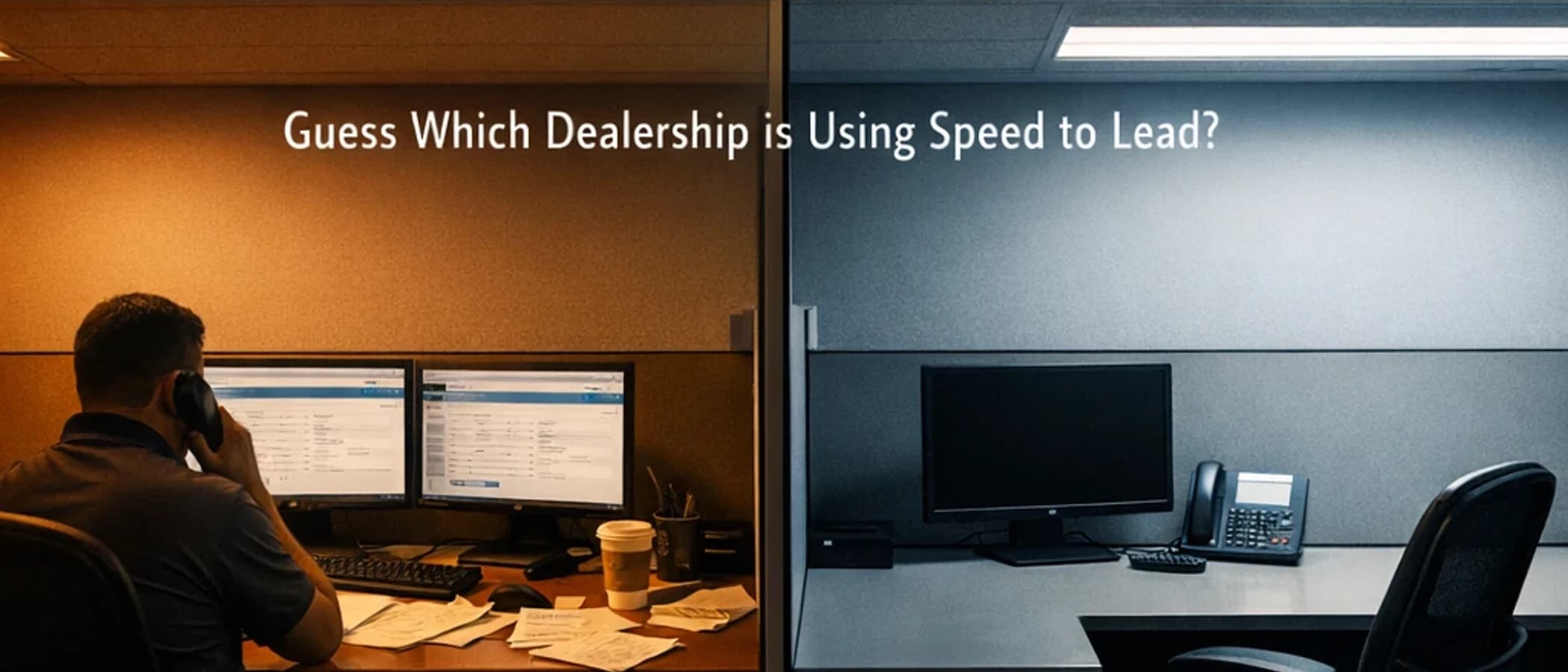
78% of car buyers choose the first dealer to respond — and the industry average response time is 1 hour 38 minutes. See how Speed to Lead replies in under 60 seconds: AI-powered SMS response that captures inbound leads 24/7 before your competitors can pick up the phone.
How Should Dealers Audit Their Own Lead Response Speed?
Mystery-shop yourself. Pam's pitch rests on a documented problem: stores routinely miss inbound contacts across calls, texts, chats, and emails (AutoSuccess, 2025). Most managers don't realize the gap exists until someone tests it from the outside. Submit a lead through your own website on a Saturday night. Call your service line during lunch. Record what happens and how long it takes. The 2026 Pied Piper study sets the benchmark - a perfect response means answering the customer's question via email, text, and phone within 15 minutes. Measure your store against that standard before a competitor does it for you.
Use this list to benchmark your store's lead handling against verified industry data:
- Measure time-to-first-text on every internet lead for one full week - text usage climbed from 38% to 54% year over year in the 2026 Pied Piper study, and phone calls rose from 66% to 75%, so both channels are accelerating (Auto Remarketing)
- Check whether each lead is logged in your CRM within one hour - 13% of leads are never logged at all (AutoSuccess, 2025), so flag any with zero recorded activity after 24 hours
- Count how many leads from the past 30 days have no follow-up activity - nearly 25% of leads industry-wide sit untouched for a full day (AutoSuccess, 2025)
- Submit a test lead from a personal email on a weekend evening and track every response across all channels
- Compare your multi-channel response rate against the 62% combination benchmark - 62% of dealerships now pair a phone call with email or text, up from 49% the prior year (Pied Piper, 2026)
The 51% perfect-response rate from the 2026 Pied Piper study is the clearest goalpost available. Hit it and you are at the industry median. Miss it and you are falling behind a standard half the market now meets. Track this metric monthly. Post the number where the BDC team can see it. Make it part of the weekly meeting.
What Does the 2026 Playbook Look Like for Top Stores?
The top stores heading into 2026 share one trait. They do not rely on a single channel or a single shift to handle leads. Text usage jumped from 38% to 54% year over year. Phone calls climbed from 66% to 75% (Pied Piper). The winners are adding channels, not swapping them. They layer text on top of phone on top of email. Coverage gaps shrink when every channel is active around the clock.
Multi-Channel Coverage Is the Baseline
62% of dealerships now use a combination of phone plus email or text to respond to internet leads - up from 49% the prior year (2026 Pied Piper). Stores still running a single-channel response are in the minority. Buyers expect immediate, multi-path contact. Meeting that expectation requires automation for the first touch and trained staff for the human follow-up. Neither alone is enough.
Independent Measurement Catches What Dashboards Miss
Internal reporting only shows what the CRM captures. Even 24/7 coverage across calls, texts, chats, and emails has blind spots. Independent measurement - like the Pied Piper Internet Lead Effectiveness study - reveals hidden breakdowns before they cost sales and erode brand trust. The best operators treat outside audits as a feature, not a threat. They want to know what breaks so they can fix it before the buyer notices.
Frequently Asked Questions
What exactly qualifies as a "perfect response" to an internet lead?
According to the 2026 Pied Piper study, a perfect response means answering the customer's specific question via email, text, and phone - all three channels - within 15 minutes. A phone call alone or a single email does not qualify. 51% of dealers now hit this benchmark, double the rate from five years ago.
How much revenue is my dealership losing from slow lead response?
U.S. dealerships lose more than $2 million each year in potential sales and service revenue tied to poor responsiveness. Nearly 25% of leads sit untouched for a full 24 hours, and 13% are never logged into a CRM at all - meaning they vanish from every pipeline and follow-up sequence permanently.
Why should we add text messaging as a first-contact channel?
Text usage for answering shopper questions jumped from 38% to 54% in a single year - a 16-point structural shift. Text works because shoppers can read and reply in seconds from anywhere. Firing a text as the first automated touch buys your BDC time to follow up by phone before the 15-minute "perfect response" window closes.
How reliable are AI-automated first replies at actually answering customer questions?
Not reliable enough on their own. The 2026 Pied Piper study found automated responses confirmed vehicle inventory only 70% of the time, confirmed test-drive availability just 36% of the time, and included a direct link to the exact vehicle only 30% of the time. Speed without substance erodes trust rather than building it.
How quickly can we realistically implement a multi-channel response process?
The core infrastructure - automated text as first touch, paired with email and phone follow-up - can be operationalized within weeks using AI-powered tools that fire SMS replies in under 60 seconds. The bigger lift is auditing and coaching: 13% of leads never enter the CRM, so mystery-shopping and independent measurement from outside your own tools are essential to diagnose true capture rates.
Should we worry about how AI search tools like ChatGPT represent our dealership?
Yes. The Pied Piper study found ChatGPT listed the target dealership first only 77% of the time - meaning in 14% of cases a competitor appeared first. Dealers cannot assume AI search assistants will route traffic accurately, making it critical to monitor how your store surfaces in conversational search results.
Related Reading
Filed underDealership OperationsService DriveAutomation

Written by the VisQuanta team
The people who build and run the Agentic Ecosystem for automotive businesses: lead response, reactivation, calls, reviews and chat, checked by a human on every account.